Prove Introduces T-Mobile MVNO Indicator for More Precise Fraud Detection
New T-Mobile MVNO Indicator brings greater precision to fraud detection, helping businesses identify risk without introducing unnecessary friction for legitimate customers.

Key takeaways
- Prove introduces carrier-confirmed MVNO intelligence, enabling businesses to definitively identify Mobile Virtual Network Operator lines on T-Mobile's network.
- Deterministic MVNO identification replaces guesswork, eliminating reliance on incomplete SIM and device tenure data to infer MVNO status.
- More precise MVNO intelligence strengthens fraud detection, helping businesses identify higher-risk scenarios and apply targeted, risk-based controls.
- Carrier-confirmed signals help reduce false positives and customer friction, minimizing unnecessary authentication challenges, manual reviews, and operational costs.
- The T-Mobile MVNO Indicator integrates seamlessly with Prove Trust Score+, delivering a new configurable MV reason code through the existing API without integration rework.
In fraud prevention, the efficacy of a decision depends on the quality of the signals behind it. For years, businesses have relied on a combination of device intelligence, telecom data, behavioral signals, and risk indicators to distinguish legitimate customers from potential fraudsters. But even sophisticated fraud strategies can be undermined by incomplete information.
The stakes are significant. According to Javelin Strategy & Research, identity fraud cost U.S. consumers $27.3 billion in 2025, while new-account fraud losses increased 13% year over year to $7 billion. As fraud threats evolve, the ability to distinguish legitimate customers from potentially fraudulent activity becomes increasingly important.
One longstanding challenge has been identifying phone numbers associated with Mobile Virtual Network Operators (MVNOs). These lines can present elevated fraud risk in certain contexts, yet reliably distinguishing them from traditional carrier lines has been difficult.
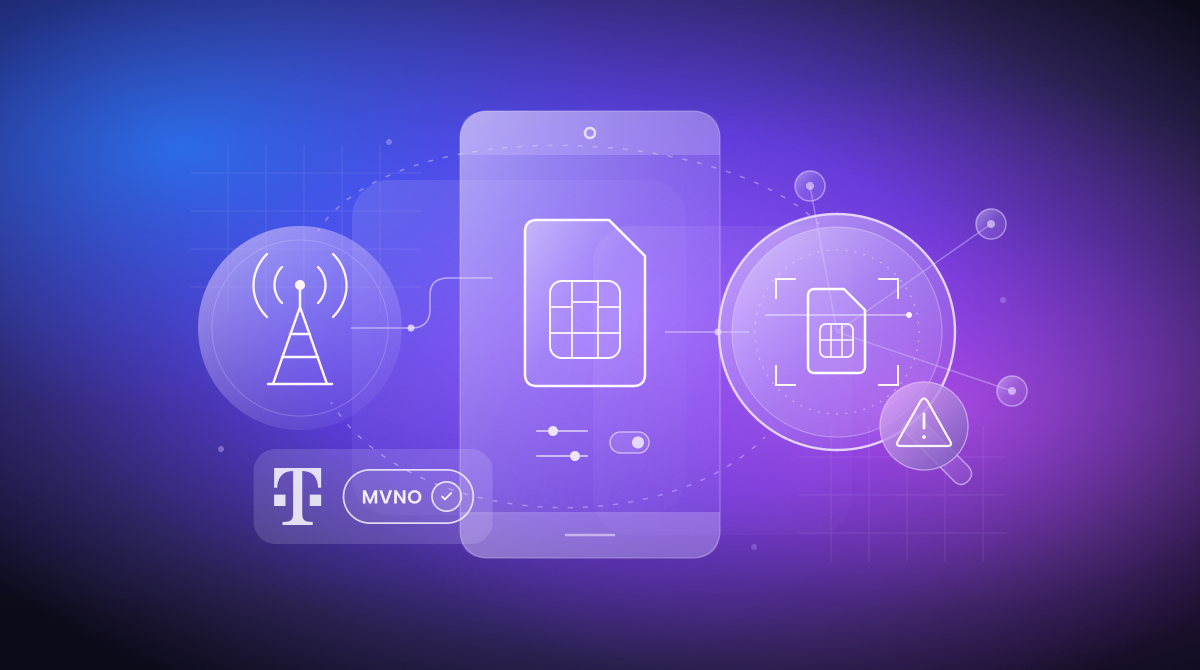
But that has now changed. Prove is introducing the T-Mobile MVNO Indicator, a new carrier-confirmed signal available through the Trust Score+ API that definitively identifies MVNO lines on T-Mobile's network.
The T-Mobile MVNO Indicator replaces uncertainty with precision, giving fraud teams a more reliable way to identify potential risk while protecting legitimate customers from unnecessary authentication challenges. Because the new capability is delivered through Prove's existing API infrastructure, customers can take advantage of this intelligence without rebuilding their integrations.
Why MVNOs Demand a More Precise Approach to Fraud
Mobile Virtual Network Operators (MVNOs) provide wireless services using larger carriers' networks, often through prepaid or lower-cost plans. While millions of legitimate consumers rely on these services, certain MVNO segments can present elevated fraud risk due to lower barriers to acquiring or replacing phone numbers.
For businesses, knowing whether a number belongs to an MVNO provides valuable fraud intelligence. But MVNO status alone does not indicate fraud. The challenge is distinguishing legitimate customers from higher-risk activity without introducing unnecessary friction.
More precise MVNO intelligence enables fraud teams to make that distinction with greater confidence.
The Problem With Inferred MVNO Risk
Until now, identifying MVNO lines on T-Mobile's network required inference from missing SIM or device tenure data. But that data could also be unavailable due to privacy opt-outs or unsupported business and government lines.
Missing data didn't necessarily mean MVNO status. Yet businesses had to either treat these numbers as potentially risky, overlook possible fraud, or introduce additional verification. The result was more false positives, unnecessary authentication challenges, higher manual review costs, and greater customer friction.
The financial consequences extend beyond direct fraud losses. According to the 2025 LexisNexis True Cost of Fraud Study, every $1 lost to fraud costs U.S. financial services organizations an average of $5.75 when additional expenses are considered. This highlights the importance of more precise fraud intelligence that helps organizations reduce unnecessary interventions while focusing resources on genuine threats.
Introducing the T-Mobile MVNO Indicator: Carrier-Confirmed Intelligence
Prove's new T-Mobile MVNO Indicator provides direct confirmation of MVNO status from the carrier. Through an enhancement to T-Mobile's Customer Type data, the carrier can now explicitly identify supported MVNO classifications using an "Unsupported Wholesale" value
Prove makes this intelligence available through a new configurable reason code, MV, in the existing Trust Score+ API response. Instead of inferring MVNO status from missing SIM or device tenure information, businesses can now receive a direct carrier-confirmed indication that a T-Mobile number belongs to an MVNO.
Note that an inferred signal suggests a possible explanation for incomplete information. A carrier-confirmed signal establishes a specific attribute of the phone line.
That greater certainty enables businesses to build more precise fraud policies, apply appropriate controls, and avoid treating unrelated customer populations as though they share the same risk characteristics.
Three Ways Carrier-Confirmed MVNO Intelligence Delivers Value
The Bigger Innovation: Moving From More Signals to Better Signals
The launch of the T-Mobile MVNO Indicator reflects a broader evolution in identity verification and fraud prevention. For years, organizations have focused on collecting more signals to improve fraud detection. But the volume of available data is only one part of the equation.
Equally important is understanding what each signal definitively establishes, what it does not, and how it should influence a decision. Missing information is not proof of risk. A particular type of phone line is not proof of fraud. And a previously trusted account does not necessarily mean the rightful user remains in control.
Effective fraud prevention requires reliable intelligence, contextual decisioning, and the ability to recognize trusted customers throughout their lifecycle. Prove's carrier-direct intelligence helps make that possible.
By transforming an ambiguous MVNO inference into a confirmed attribute, Prove is enabling businesses to make more informed decisions while reducing unnecessary friction.
To learn more about the T-Mobile MVNO Indicator and how to enable it through Trust Score+, contact your Prove representative.
The modern
way of proving identity
Trusted by 2,000+ leading companies to reduce fraud and improve consumer


Frequently Asked Questions
The T-Mobile MVNO Indicator is a carrier-confirmed fraud intelligence signal that identifies Mobile Virtual Network Operator (MVNO) phone lines on T-Mobile's network. Available through Prove's Trust Score+ API, it uses a new configurable reason code (MV) to provide deterministic MVNO identification, replacing previous methods that relied on inferred SIM and device tenure data.
Carrier-confirmed MVNO identification helps businesses distinguish potentially higher-risk phone lines from legitimate customers whose telecom data may be unavailable for other reasons. By combining confirmed MVNO status with identity, device, and behavioral signals, fraud teams can apply more targeted controls, reduce false positives, minimize unnecessary authentication challenges, and lower manual review costs.
Businesses can access the T-Mobile MVNO Indicator through Prove's existing Trust Score+ API. The new MV reason code is configurable and additive, requiring no changes to the API response structure or existing integrations. Once enabled, organizations can incorporate carrier-confirmed MVNO intelligence into their fraud detection rules and risk-based authentication strategies.
Keep reading
 Read the article: Prove Brings Together Industry Leaders to Tackle Trust Challenges in AI-Driven Payments
TikTok, Velocity, Worldpay and others convene to address emerging risks across identity verification, agentic liability, and the future of payments
 Read the article: Traceable evidence will form the basis of AI agents: Authenticate 2026 speakers
Experts from Consult Hyperion, Prove, NIST, iProov identify biometric binding, liveness among key tools
 Read the article: Rodger Desai on Continuous Identity and Trust in the AI Era
In this interview with Investment Reports, Prove Founder and CEO Rodger Desai explains how AI is changing identity and fraud prevention, why trust must be continuous, and how cryptographic binding can help secure human- and agent-led transactions.