What's Next for Payments & Crypto? 5 Insights from Visa, PayPal, Amazon, Stripe, and More
Explore 7 payments and crypto predictions for 2027 from Trust 25 leaders, covering stablecoins, AI agents, fraud prevention, digital identity, and payment security.


Key takeaways
- AI agents are redefining payment authorization. Leaders at Visa, Amazon, and PayPal highlight the growing importance of consumer intent, permissions, and accountability.
- Stablecoins are transforming global payments. BVNK sees stablecoins enabling faster, more efficient cross-border transactions and settlement.
- AI-powered fraud is accelerating. Leaders at Bank of America and PayPal emphasize contextual intelligence and stronger fraud prevention.
- Continuous identity verification is replacing one-time checks. Experts at Stripe, U.S. Bank, and AvidXchange advocate for ongoing identity assurance and risk-based authentication.
- Trust is becoming foundational payment infrastructure. Perspectives from Amazon, Visa, and Stripe point to a future connecting identity, authorization, fraud prevention, and agentic commerce.
Stablecoins are creating new possibilities for moving money across borders. AI agents are changing how consumers discover products, make purchasing decisions, and initiate payments. Meanwhile, increasingly sophisticated fraud is challenging financial institutions to deliver faster, more seamless transactions without compromising security.
Leaders at Visa, PayPal, Amazon, Stripe, BVNK, Bank of America, U.S. Bank, and AvidXchange are confronting these developments from different perspectives, but their insights point to a common challenge: How can businesses establish identity, verify authorization, and maintain trust as payments become increasingly instantaneous, interconnected, and autonomous?
To explore what's next, we turned to the honorees of Prove's Trust 25, a recognition program celebrating 25 innovators across Payments, Agentic Commerce, Identity, Customer Experience, and Fraud & Compliance.
Drawing on their perspectives, we've identified five predictions for payments and crypto in 2027, spanning stablecoin adoption, AI-powered fraud, agentic payments, continuous authentication, and the emerging infrastructure required to support trusted digital transactions.

1. AI agents will fundamentally change how payments are initiated and authorized
For decades, digital payment systems have largely assumed that a person is actively participating in a transaction. Even when payments are automated, the underlying authorization models are generally built around established relationships between people, merchants, and financial institutions.
AI agents introduce a different model. An agent might research a product, compare prices, select a merchant, and complete a purchase on someone's behalf. The transaction could be legitimate without the customer ever directly interacting with the checkout page.
Gautam Poornachandra, Product Lead for Agentic AI Payments at Amazon, sees automated payments, AI, and emerging open standards transforming checkout experiences. His perspective highlights how payments, identity, fraud prevention, compliance, and customer experience are related and must work together. As agentic commerce develops, these functions must work together rather than operate as independent checkpoints.
Harsh Dev, Head of Product for Consumer, Transaction Risk & Credit Risk Platform at PayPal, anticipates a related shift: trust moving from individual transaction validation toward the safe delegation of authority.
2. Stablecoins will put new demands on payment infrastructure and identity
Stablecoins have the potential to change how businesses move money internationally, settle transactions, and deliver financial services. But faster settlement and more programmable payment infrastructure introduce new questions about identity, compliance, and transaction accountability.
A payment can move efficiently across a blockchain while leaving unresolved questions about the parties involved, the legitimacy of the transaction, or whether the person or system initiating it was authorized to do so.
Amit Cheela, U.S. CEO of BVNK, works at the intersection of digital assets and traditional payment infrastructure. He sees that these challenges are especially relevant as stablecoins move into more mainstream payment use cases. For Amit, the broader implications extend beyond stablecoins themselves. Financial institutions and payment providers will need to connect emerging payment rails with reliable identity, fraud prevention, and compliance controls.
3. Payment fraud prevention will shift from individual signals to contextual intelligence
Financial institutions have access to more information about transactions, devices, customers, and behavior than ever before, but more information does not automatically produce better decisions.
Harsh Dev challenges the assumption that collecting more data necessarily improves risk assessment. The approach he prefers is one that emphasizes the quality and relevance of signals rather than their sheer volume. The reason is that fraudsters use AI to scale impersonation, social engineering, and other attacks, so volume is less relevant, while quality can be understood in context.
Rather than relying on isolated transaction events, organizations can evaluate identity and risk in context throughout a customer's experience. For example, Thomas Schraufnagel, SVP of Authentication & Identity Product at U.S. Bank, emphasizes the importance of bringing information together to support more granular decisions.
For payments and crypto businesses, that means combining identity confidence, device information, account history, transaction behavior, and other relevant signals to make more informed decisions.
4. Continuous trust will replace one-time authentication
Traditional authentication often treats trust as a checkpoint. A customer logs in, completes an authentication challenge, and receives access. Subsequent activity may trigger additional checks based on predefined rules.
But the legitimacy of a customer at login does not necessarily establish the legitimacy of every subsequent action. Schraufnagel identifies continuous trust as an important evolution in identity and authentication. His approach emphasizes evaluating contextual signals throughout a session and adapting security to the level of risk.
Deniz Ertan, Senior Director of Risk, eBay, offers a complementary perspective. Rather than assuming more friction produces greater security, Ertan advocates for dynamic verification based on the circumstances and severity of an interaction.
This has become essential in payments. A routine purchase and a high-value transfer should not necessarily require identical treatment. For digital asset businesses, continuous trust may also become important when evaluating wallet access, withdrawals, account changes, and other sensitive activities.
5. The next payment experience will make security less visible, but more intelligent
Consumers rarely evaluate payment experiences based on the sophistication of the underlying fraud controls. They notice whether a payment works, whether it happens quickly, and whether something unexpected prevents them from completing a transaction.
Harsh Dev describes trust in financial services as something that should feel seamless when systems are functioning correctly.
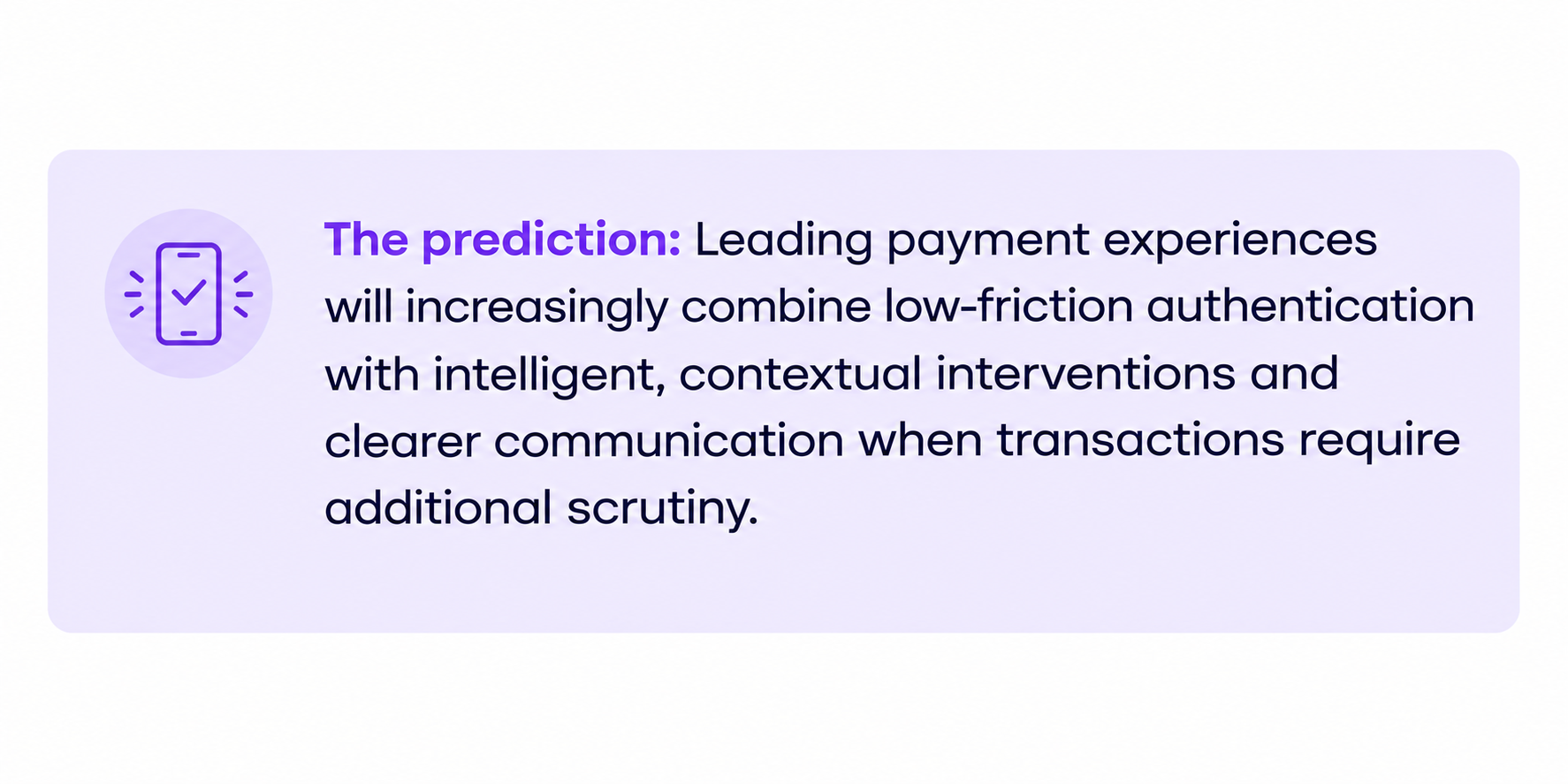
He also emphasizes transparency when a transaction cannot proceed as expected. This points toward a more sophisticated understanding of customer experience. Gautam Poornachandra similarly emphasizes consistency across the full transaction lifecycle, including the support customers receive when something goes wrong.
The objective is not to eliminate security interventions. Rather, it is to apply the right intervention at the right moment, while explaining what is happening when additional verification is necessary.
What payments and crypto leaders should prepare for in 2027
The next generation of payments will create opportunities for faster transactions, more seamless experiences, and entirely new commercial models.
But speed alone will not determine which innovations succeed. The organizations best positioned for the next era will be those capable of establishing reliable identity, understanding authorization, evaluating risk in context, and maintaining accountability across increasingly complex transactions.
The modern
way of proving identity
Trusted by 2,000+ leading companies to reduce fraud and improve consumer


Frequently Asked Questions
The biggest payments and crypto trends for 2027 include stablecoin adoption, AI-powered agentic payments, real-time fraud detection, continuous identity verification, and more secure cross-border transactions. According to Prove's Trust 25 leaders, these innovations will make digital payments faster, more automated, and increasingly dependent on trusted identity and authorization.
AI and agentic commerce will transform digital payments by enabling autonomous agents to initiate purchases and transactions on behalf of consumers. This shift will require payment providers to verify agent identities, confirm consumer authorization, enforce spending permissions, and prevent AI-driven fraud while maintaining seamless payment experiences.
Stablecoins are expanding the possibilities for faster cross-border payments, settlement, and global money movement. As adoption grows, banks, fintechs, and crypto platforms will need stronger digital identity verification, continuous authentication, fraud prevention, and compliance infrastructure to support secure, trustworthy transactions.
Keep reading
 Read the article: Prove Unveils Inaugural Trust 25 Honoring Leaders from Citi, Bank of America, and Uber
Prove has launched the Trust 25, an inaugural recognition program for 25 executives from top firms like Citi and Uber who are advancing digital identity and fraud prevention in the AI era.
 Read the article: Prove Unveils The Trust 25, Recognizing Leaders From Uber, Citi, PayPal, Visa, and 20+ Other Organizations Solving the Hardest Problems in Digital Identity
Prove announces the 2026 Trust 25, honoring 25 leaders from Uber, Citi, PayPal, Visa and more advancing digital identity, fraud prevention and AI-driven trust.
 Read the article: Prove Unveils The Trust 25, Recognizing Leaders From Uber, Citi, PayPal, Visa, and 20+ Other Organizations Solving the Hardest Problems in Digital Identity
Honorees span banking, payments, gaming, and technology, reflecting the breadth of industries now confronting AI-driven fraud, authentication, and the rise of AI agents