College Ave is a leading private student loan provider focused on delivering a simple, fast, and affordable lending experience for students and families.
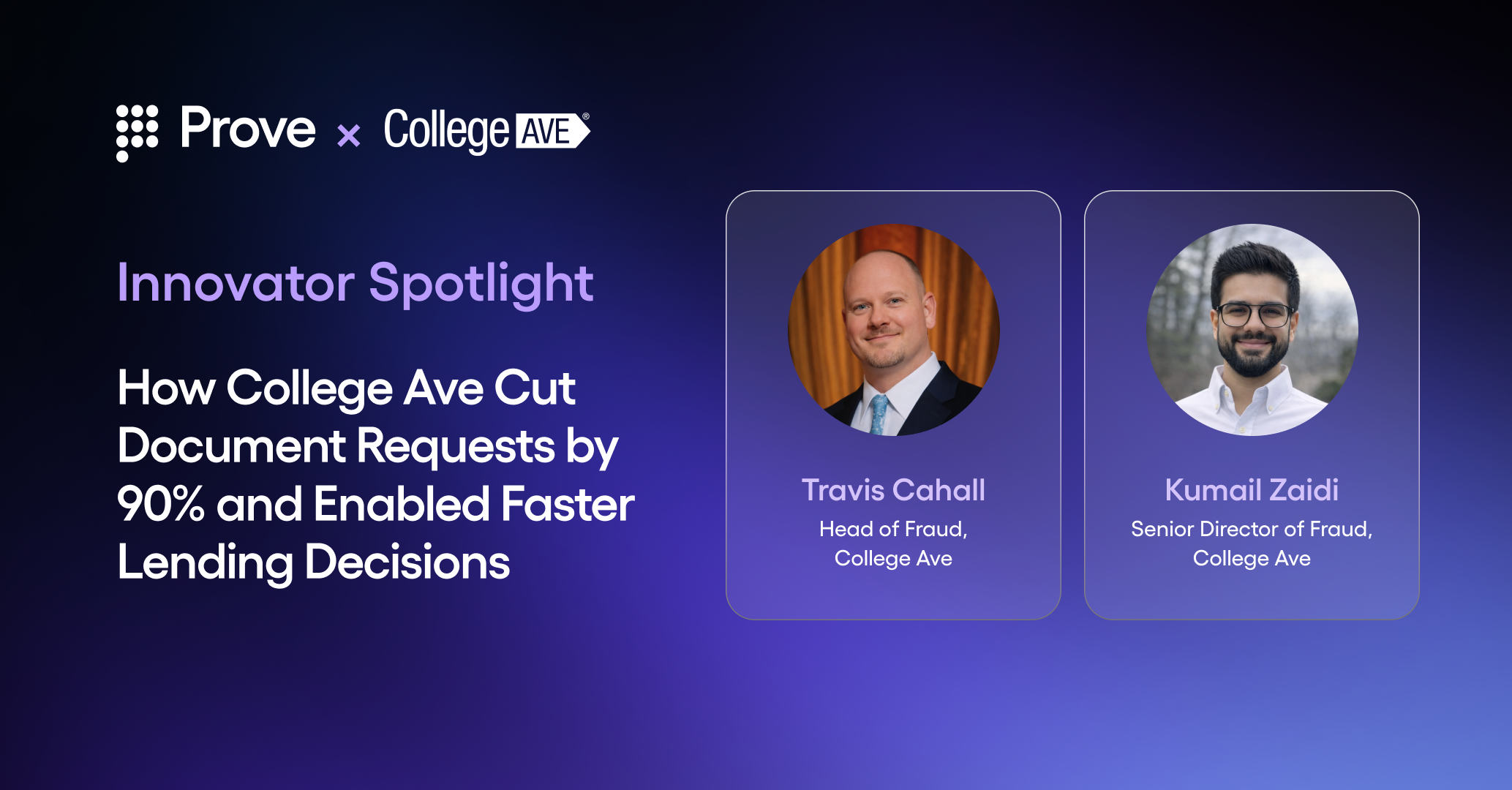
When Travis Cahall (Head of Fraud) and Kumail Zaidi (Senior Director of Fraud) joined College Ave, they inherited a problem the industry had largely underestimated: fraud in student lending was far more complex than the existing playbook was built to handle.
Student lending is a uniquely difficult environment for identity verification. Many applicants are 18–19 years old with little to no credit history. At the same time, fraud is evolving, driven by several major trends:
The existing model relied on manual reviews and document uploads - processes which are notoriously slow, inconsistent, and hard to scale.

“In student lending, you’re dealing with borrowers who often have little to no credit history. If your model depends on traditional data, it’s going to break. You need a different way to establish trust.”
— Kumail Zaidi, Senior Director of Fraud, College Ave
Cahall and Zaidi rejected the idea that fraud prevention requires more friction. Instead, they focused on a different principle: fraud detection should be more precise, not more restrictive.
“The industry’s default response to fraud has always been to add more friction. The problem is that approach slows down good borrowers without actually stopping sophisticated fraud. We wanted a system that does both better.”
— Travis Cahall, Head of Fraud, College Ave
Their goal was clear: stop fraud more accurately while enabling legitimate borrowers to move faster.
“If you’re putting friction on the wrong people, you’re failing twice—you’re letting fraudsters through and turning away legitimate borrowers.”
— Kumail Zaidi, Senior Director of Fraud, College Ave
They built a layered fraud stack with Prove as a core partner, designed to evaluate identity in real time.
“The shift that made everything work was moving from a vendor relationship to a true partnership. A vendor gives you an answer. A partner helps you build a system that gets better over time.”
— Travis Cahall, Head of Fraud, College Ave
Rather than relying on a single verification step, the system evaluates multiple signals simultaneously, allowing College Ave to make decisions in real time:
“What we’ve proven is that better fraud detection doesn’t require more friction. If anything, the more precise your system is, the less friction you need.”
— Kumail Zaidi, Senior Director of Fraud, College Ave
Fraud is becoming more sophisticated, particularly with the rise of synthetic identities and AI-driven attacks.
For Cahall and Zaidi, the next frontier is intent—understanding not just whether an identity is valid, but whether an application actually makes sense.
That shift reflects a broader change in how fraud needs to be approached.
It’s no longer about adding more checks or slowing down the process. It’s about building systems that can make better decisions in real time - applying friction only where it’s needed and removing it everywhere else.


“Once you stop thinking about fraud and customer experience as separate problems, you can design a system that improves both at the same time.”
— Kumail Zaidi, Senior Director of Fraud, College Ave
For lenders, the implication is straightforward: fraud prevention doesn't have to come at the expense of growth or customer experience. With the right signals and the right approach, it can actively drive both.


.png)


