Why marketplaces are uniquely exposed

Mark Shneyderman
July 3, 2026

10 mins read

Marketplaces are two-sided trust environments, and that structure makes them an attractive target for fraud. Five patterns account for most of the damage: fake seller listings, account takeover, chargeback abuse, triangulation fraud, and promotion abuse. All five exploit the same gap one-time identity checks can’t keep pace with the full transaction lifecycle. Continuous, deterministic identity verification closes that gap without turning onboarding into a bottleneck.
The Core Angle
The digital world needs a method for two parties to exchange information, goods and services. Marketplaces fulfil that role, by enabling owners to take their business online, increasing reach, profitability and relevance. In 2026, ecommerce sales are projected to reach $6.88 trillion, making up 21.6% of total worldwide retail sales. The massive scale of digital operations in the current era comes with its own set of challenges as well. The intervention of fraudulent parties in ecommerce has been an ongoing challenge as the industry grows with incredible momentum. Fundamentally, it must come down to trust. Identity verification is a non-negotiable requirement in the digital world. With the rise of AI, sophisticated fraud methods becoming mainstream and mass sourced, KYC ceases to be an optional check.
1. Why marketplaces are uniquely exposed
Marketplaces are people-first industries. On a fundamental level, the trust within a marketplace environment comes down to how easily two people can verify each other’s legitimacy, and engage in business. The seller must be confident that the person buying from them does not have malicious intentions to charge back their product or misrepresent their service in a later review in order to claim money back. On the converse, the buyer wants to be absolutely sure that they are getting what they paid for. It is precisely in moments like these that fraud thrives, any inconsistency can be manipulated into confusion, frustration and monetary losses. Verification is required at multiple touchpoints within the marketplace economy. Not only do the users need to be verified and accounted for but their goods and services also must be held to the same standards.
Trust becomes the main growth driver within marketplaces, an economy of transparency eliminates churn, minimizes fraud and accurately represents supply and demand within the ecosystem. As users find more power to become their own business owners, their identities as buyers, sellers, drivers, agents and hosts depend on accurate verification to ensure they are operating within high trust digital environments.
2. The fraud patterns
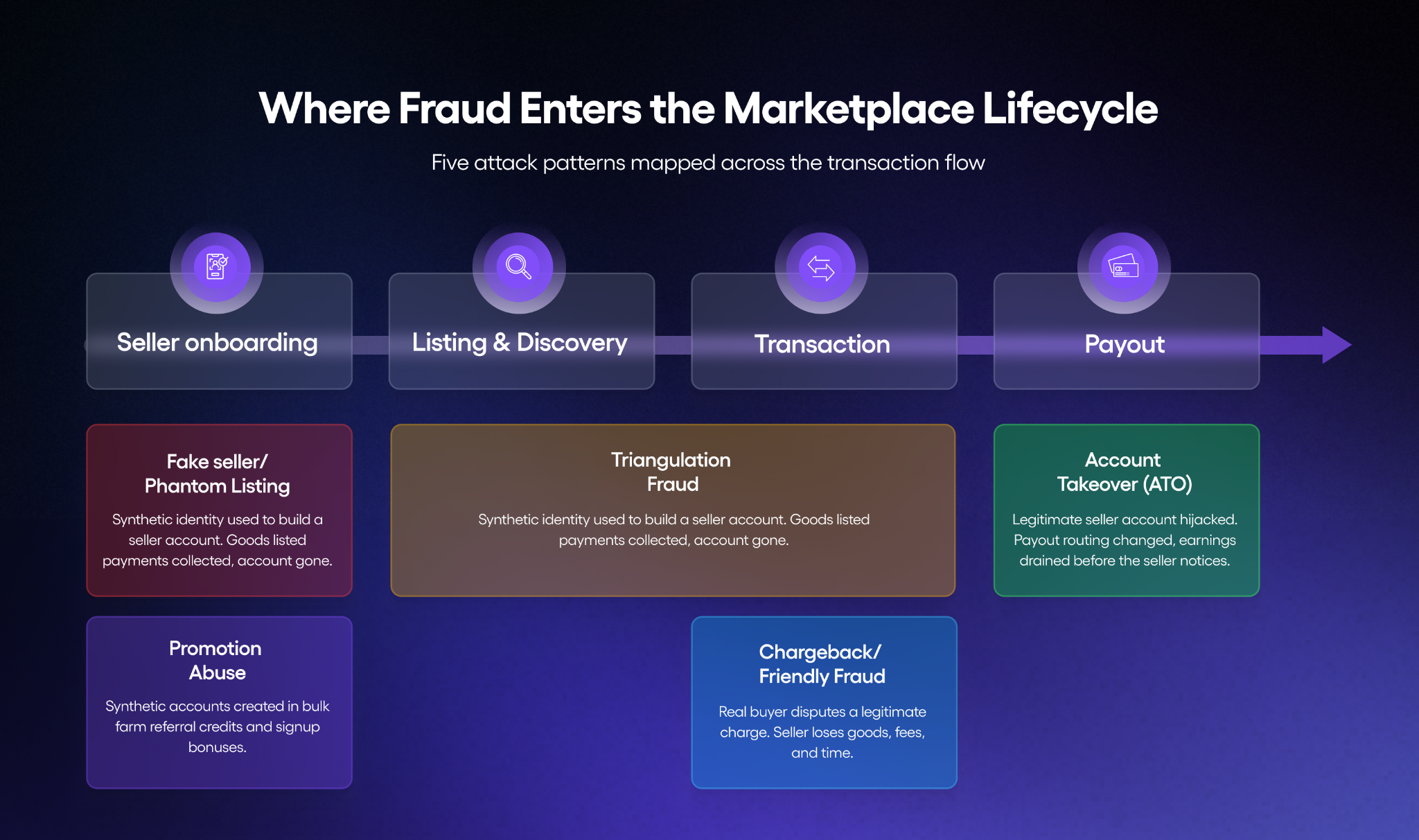
Common fraud patterns emerge within digital marketplaces. As certain patterns and pain points are identified, the gaps point towards a greater story. One time checks and knowledge based authentication are simply not effective any longer. With the rapid development of fraud methods, fraud detection needs to keep up the pace. Deterministic and continuous identity verification will be the key that allows marketplaces to unlock trust within their spaces.
- Fake seller / phantom listing fraud
Fraudsters may create legitimate seller accounts with fake listings. The account can appear as perfectly credible and may even be verified and yet the products listed will never get to the customer since they are not real. Synthetic identity is a real driver behind this type of attack. 75% of financial institutions expect document forgery to undermine their current verification controls within the next year (Prove State of Identity Report 2026)
- Account takeover (ATO) on sellers
Account takeover fraud is an insidious, parasitic method of attack. A seller’s account may get hijacked with their payout routing being changed and funds being funneled away from their account into the fraudster’s pocket. The worst part, the seller may not find out until “payday” occurs, only to find none of the funds deposited in their account. By the time any fraud is noticed, the bad actors have already cleared their tracks. Such examples highlight the need for continuous identification, if caught, the fraudster’s scheme can be curbed way before payday.
- Friendly fraud / chargeback abuse
Chargeback abuse is another way sellers may have their money hemorrhage out of their accounts. When malignant buyers decide to charge back, even though they received the goods, the seller suffers. Many have to endure shipping, material, time costs when the goods they worked to deliver to the customer are simply refunded without themselves being returned.The structural problem is that most platforms have no visibility after login. 68% of organizations lack continuous authentication across the user journey (Prove State of Identity Report 2026), which means chargeback abuse and other post-transaction fraud often go undetected until the damage is done.
- Triangulation fraud
Triangulation fraud is insidious. The fraudster creates a fake storefront posing legitimate goods. Then as a customer makes a purchase, the fraudulent store fulfils the order by utilizing stolen card information to fulfil the order. The fraudster acts as an invisible middle man, pocketing the initial money, leaving whoever’s card information was used at the mercy of chargebacks and disputes. The customer may not even have any clue that this happened, after they received the item directly from the supplier.
- Promotion / incentive abuse
Here is the scenario, a store creates a large promotion event online for early stage users. Malicious actors can then create bot farms to flood the platform with fake accounts in order to receive thousands in promotional material. Worst of all, this is very hard to detect as the initial promotion is aimed at users with low lifetimes on the platform. It is the fastest growing e-commerce fraud threat.
3. Where IDV intervenes in this map
Given the common fraud patterns and the transactional nature of marketplaces, identity verification becomes an important element in establishing trust between the parties involved. The above patterns rely on attackers misrepresenting themselves, obscuring their image in order to fabricate trust and cause mischief. Transactions within marketplaces often consist of multiple touchpoints. This is exactly why continuous identity verification is needed, as opposed to one time identity checks which become lackluster in the context of the transaction lifecycle.
4. The friction tradeoff
To some, identity verification can be seen as friction, slowing down conversion rates. It’s true, friction is real, at every extra step in onboarding, an inevitable percentage of customers will be lost. That’s why verification has to be done in a smart way, instead of bombarding users with OTPs or knowledge checks, continuous background identity checks can maintain a healthy balance between speed and security within marketplace environments. Naturally some solutions do better than others, as long as the focus is on deterministic, continuous identity checks, both sides of the marketplace are in good hands, without sacrificing speed or security.
Frequently Asked Questions



