Beyond the OTP: What’s Driving the Next Generation of Authentication in Online Gaming
Learn why online gaming authentication is moving beyond passwords, SMS OTPs, and traditional MFA toward continuous, risk-based trust. Explore how persistent identity, cryptographic possession, device and network intelligence, and adaptive authentication can help gaming operators reduce fraud while creating a more seamless player experience.


Key takeaways
- Gaming authentication must extend beyond login. Trust needs to be evaluated across the player lifecycle, including deposits, withdrawals, device changes, account recovery, and other high-risk events.
- More MFA does not automatically mean stronger identity assurance. OTPs and other conventional factors can be intercepted, phished, redirected, or socially engineered.
- Persistent identity provides stronger context for authentication decisions. Combining identity history with device, network, possession, and risk signals helps determine whether the trusted player remains in control.
- Authentication should adapt to risk. Low-risk, recognized players can authenticate seamlessly, while changes in context or higher-risk actions can trigger additional assurance.
- Authentication is becoming part of the player experience infrastructure. The goal is to strengthen fraud protection while reducing unnecessary friction; maintaining trust rather than repeatedly forcing legitimate players to re-establish it.
Online gaming has outgrown login-based authentication.
A player can move from account access to deposits, wagers, payment changes, withdrawals, device changes, and account recovery in a matter of minutes, with the level of risk changing at every step. Yet much of the industry's authentication infrastructure still treats trust as a point-in-time decision, relying on passwords, SMS OTPs, and conventional MFA to establish that a user is legitimate and then carrying that assumption forward.
A modern gaming account is a persistent financial and identity relationship, and protecting it requires authentication that can recognize trusted players, detect when the context changes, and adjust assurance continuously across the player lifecycle.
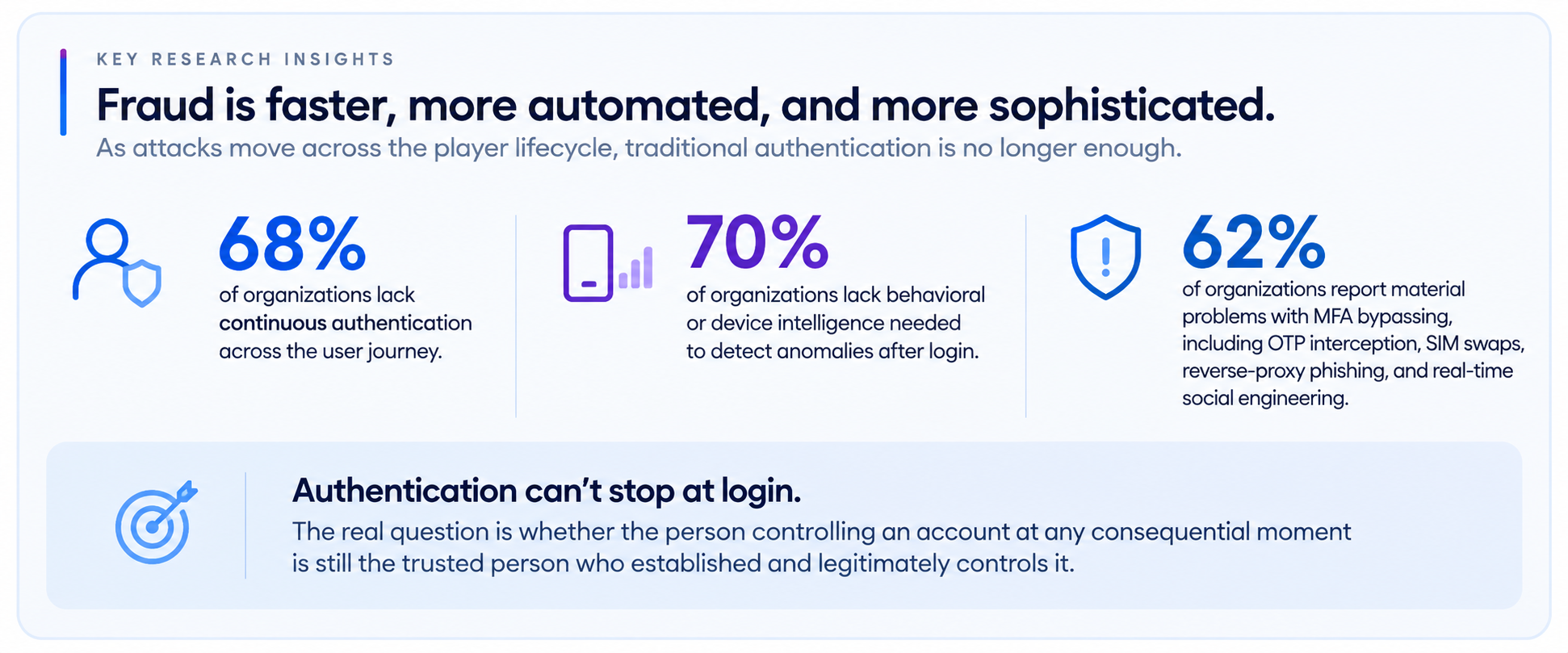
Prove's State of Identity Report 2026 found that 68% of organizations lack continuous authentication across the user journey and 70% lack the behavioral or device intelligence needed to detect anomalies after login. The same research found that 62% of organizations report material problems with MFA bypassing, including attacks involving OTP interception, SIM swaps, reverse-proxy phishing, and real-time social engineering. The problem, in other words, is no longer simply determining whether someone can successfully authenticate at the beginning of a session. The harder question is whether the person controlling an account at any consequential moment is still the trusted person who established and legitimately controls it.
This distinction is driving a significant change in authentication architecture, and the engine for the new model is Prove Unified Authentication℠.
Instead of treating authentication as a succession of challenges, organizations must build systems around persistent identity, cryptographic possession, continuous risk evaluation, and intelligent authentication orchestration. For online gaming operators, this means moving toward an architecture capable of recognizing trusted players in the background, maintaining identity context across sessions and devices, evaluating changes in risk, and introducing additional friction only when the available evidence no longer supports the required level of assurance.
Why can't gaming operators just protect the login anymore?
The traditional perimeter around a gaming account was simple: protect the login. But today, some of the most consequential fraud now occurs after authentication, as attackers exploit gaps between sessions, devices, transactions, and account changes. For gaming operators, that creates risk across the entire player lifecycle:
- Account takeover: Stolen credentials or session tokens can give attackers control of legitimate player accounts after authentication.
- Account recovery abuse: Fraudsters can manipulate recovery flows to reset credentials, replace authenticators, or take control of an established account.
- Payout and withdrawal fraud: An attacker controlling a legitimate account can change payment or payout information and attempt to extract funds.
- Synthetic identity and promotion abuse: Fraudsters can establish accounts with synthetic or stolen identities, build apparently legitimate histories, and monetize them later through bonuses, promotions, or other abuse.
- Age and eligibility evasion: Underage, excluded, or otherwise ineligible players can attempt to establish new identities and accounts to circumvent platform controls.
- Device and channel changes: Movement between mobile, desktop, browsers, and new devices creates a critical question: Is this normal player behavior, or has control of the account changed?
The architectural implication is that authentication cannot stop at login because risk does not stop at login.
Instead, authentication needs to become event-aware. A player opening an app from a recognized device that has been associated with the account for a long period of time presents a very different risk profile from the same account initiating recovery from a new device and then immediately requesting a withdrawal. Treating both interactions with the same authentication workflow ignores much of the information available to the operator.
A more mature architecture uses identity history, device possession, network intelligence, lifecycle events, and fraud signals to determine the assurance appropriate to the action being attempted.
Why more MFA is not the same as stronger identity assurance
Adding authentication factors does not automatically create greater certainty about identity. Prove's State of Identity Report found that 62% of organizations report material issues with MFA bypassing, while only 28% believe single-signal authentication is sufficient. The problem is that many conventional factors still rely on evidence that can be transferred, intercepted, phished, or socially engineered. An OTP may prove access to a phone number at a particular moment, for example, without proving that the legitimate player remains in control of the trusted device or account.
The stronger model combines cryptographic possession with persistent identity and real-time risk signals. A device-bound cryptographic key can prove possession without transmitting a reusable secret, while device, network, behavioral, and identity context help determine whether the interaction remains consistent with the trusted player. The goal is not simply to add more factors or replace OTP with another login method; it is to make a stronger identity decision using multiple forms of evidence.
What is actually happening inside Unified Authentication
Prove Unified Authentication is an intelligent authentication orchestration layer. For a returning user, it first looks for the strongest available low-friction evidence and evaluates it alongside fraud and risk signals through Prove's Global Fraud Policy. When confidence is high, authentication can happen silently; when signals are insufficient or risk increases, the system steps up to another method. This adaptive waterfall is critical in gaming, where players move across devices, browsers, networks, and risk levels. Instead of forcing every player through the same authentication flow, Unified Authentication applies the right level of assurance for the specific interaction, escalating only when necessary.
Technically, the architecture can be understood as a decision loop rather than a login flow:
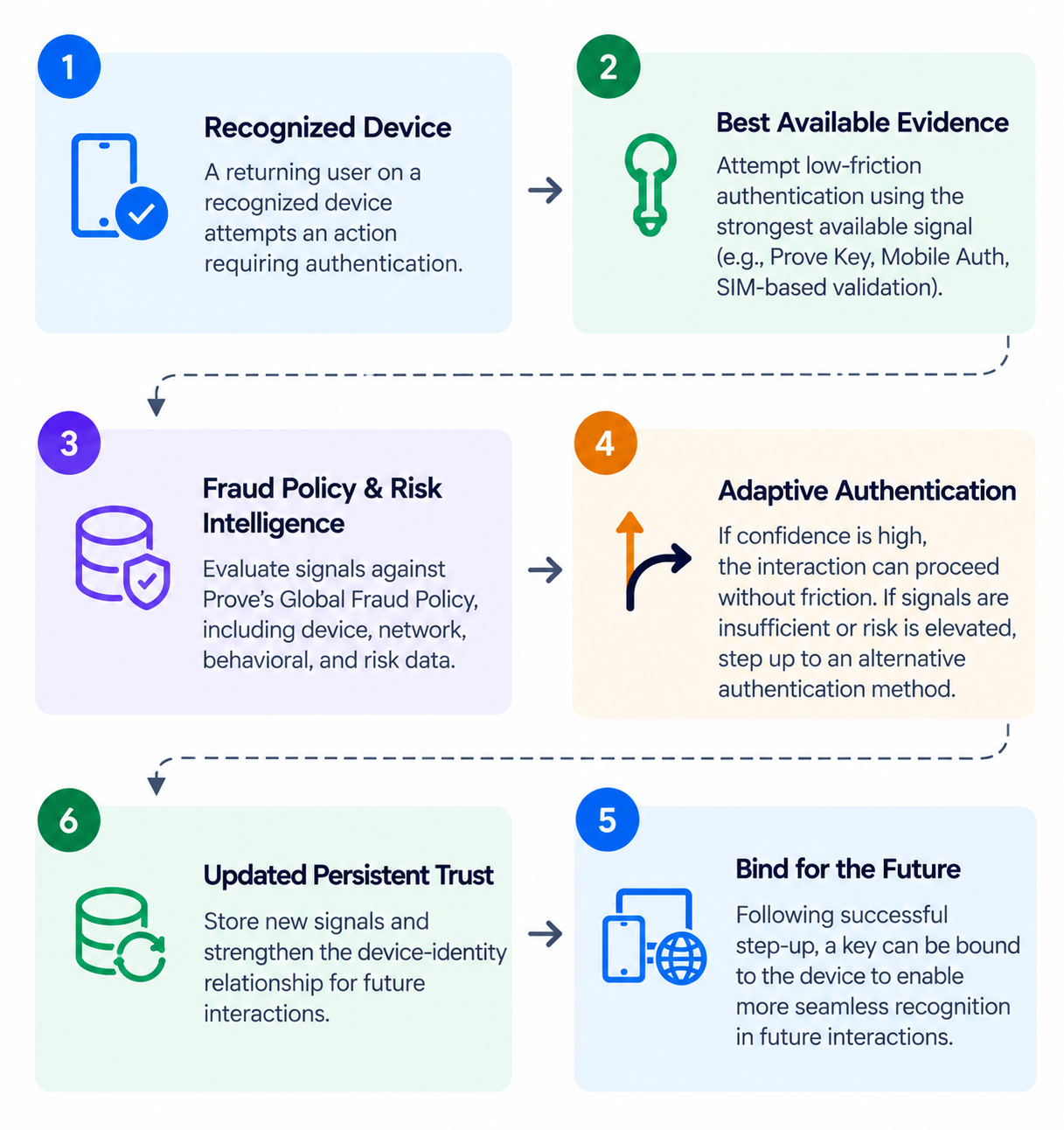
A successful interaction should not simply terminate with an "authentication passed" response. It can contribute evidence to the ongoing identity relationship so that the next interaction begins with more context than the previous one. That is the difference between authentication as a transaction and authentication as persistent infrastructure.
How does persistent identity change what operators know about returning players?
Conventional authentication asks what a player can prove now. Persistent authentication adds another question: What do we already know about this player, this account, this device, and the relationship among them, and what has changed since the last trusted interaction?
A legitimate player can accumulate months or years of trusted history: devices, possession relationships, successful authentications, account activity, and other continuity signals. An attacker may obtain a password, steal PII, intercept an OTP, or compromise an individual session, but reproducing the accumulated history surrounding a legitimate identity is considerably more difficult. As AI makes point-in-time impersonation easier, that historical context becomes increasingly valuable. The State of Identity Report's central argument is that static identity systems are failing because trust is established at one moment and then assumed as context changes; persistent identity instead allows confidence to be continuously re-evaluated as devices, behavior, and risk signals evolve.
Prove's Identity Platform is designed around the idea that verification, authentication, fraud prevention, and persistent identity should share context rather than operate as disconnected systems. Prove describes the underlying problem succinctly: every handoff between fragmented identity systems creates another potential gap. For gaming operators managing onboarding, age and identity requirements, authentication, account access, payments, withdrawals, responsible gaming controls, and recovery, reducing those gaps can be as important as improving any single control.
Authentication is essential to the player experience infrastructure
Hard Rock Bet offers a good example of what happens when identity and authentication are designed as part of the player experience rather than added as separate checkpoints. Behind its streamlined onboarding experience, Prove helps orchestrate identity verification and authentication, with signups evaluated against Prove's Global Fraud Policy to identify risks including identity theft, SIM swaps, recycled numbers, and synthetic fraud. The result demonstrates an important principle for gaming operators: stronger identity controls and a faster player experience do not have to be competing objectives.
That principle extends well beyond onboarding. The next generation of gaming authentication is about connecting identity, possession, device and network intelligence, risk, and authentication so operators can determine not only who the player is, but whether the person controlling the account remains consistent with that trusted identity as the relationship evolves. Cryptographic possession provides stronger evidence, persistent identity supplies history, risk intelligence provides context, and orchestration determines when additional assurance is actually necessary.
Authentication can therefore become an intelligent trust layer operating throughout the player lifecycle by recognizing trusted players when confidence is high, detecting meaningful changes in context, and stepping up only when the evidence requires it. The goal is no longer simply to prove that someone can log in. It is to maintain confidence that the trusted player remains in control at every moment that matters.
The future of gaming authentication Is continuous trust
Ultimately, the future of gaming authentication is about maintaining trust, not repeatedly re-establishing it. By combining persistent identity, cryptographic possession, real-time risk intelligence, and adaptive authentication, operators can strengthen account security while reducing unnecessary friction for legitimate players. As fraud becomes faster and more automated, that ability to recognize trusted players, and respond intelligently when something changes, will become a critical part of both security and the player experience.
The modern
way of proving identity
Trusted by 2,000+ leading companies to reduce fraud and improve consumer


Keep reading
 Read the article: Prove Unveils Inaugural Trust 25 Honoring Leaders from Citi, Bank of America, and Uber
Prove has launched the Trust 25, an inaugural recognition program for 25 executives from top firms like Citi and Uber who are advancing digital identity and fraud prevention in the AI era.
 Read the article: Prove Unveils The Trust 25, Recognizing Leaders From Uber, Citi, PayPal, Visa, and 20+ Other Organizations Solving the Hardest Problems in Digital Identity
Prove announces the 2026 Trust 25, honoring 25 leaders from Uber, Citi, PayPal, Visa and more advancing digital identity, fraud prevention and AI-driven trust.
 Read the article: Prove Unveils The Trust 25, Recognizing Leaders From Uber, Citi, PayPal, Visa, and 20+ Other Organizations Solving the Hardest Problems in Digital Identity
Honorees span banking, payments, gaming, and technology, reflecting the breadth of industries now confronting AI-driven fraud, authentication, and the rise of AI agents


