Stop Account Takeover Fraud Without Slowing Down Real Customers in the Contact Center
Learn how Prove for Amazon Connect helps banks and insurers prevent account takeover, authenticate callers, reduce handle time, and improve customer experience.


Key takeaways
- Contact centers are a growing target for account takeover.
- Legacy KBA creates friction without stopping modern fraud.
- Prove authenticates trusted callers before they reach an agent.
- High-risk interactions receive seamless step-up verification.
- Organizations can reduce fraud, handle time, and operating costs.
The contact center has quietly become one of the most exposed channels in financial services, combining inherent vulnerabilities with a low barrier to sophisticated attacks.
Consider that, for contact centers, a fraudster doesn't need to breach a system or crack a password. Equipped with just a customer’s name and date of birth, they can call a contact center and talk their way past an agent. With that access, they can authorize a wire transfer, redirect a return premium, change a beneficiary, or take over an account outright, all before anyone realizes the caller wasn't who they claimed to be.
A new approach to stopping fraud in contact centers is long overdue, and that's why we're excited to announce Prove for Amazon Connect, a new integration that brings Prove's identity verification and authentication directly into the Amazon Connect contact center platform. Built on AWS and available through the AWS Marketplace, Prove for Amazon Connect helps banks, credit unions, and insurance carriers stop account takeover (ATO) fraud, cut average handle time, and deliver a friction-free experience to the legitimate customers who routinely make use of company contact centers.
The problem: legacy authentication has become obsolete
For years, contact centers have leaned on Knowledge-Based Authentication (KBA), which uses those "what's your mother's maiden name" questions to verify callers. In an era of mass data breaches, social engineering, and AI-driven fraud, that approach is inadequate, and here’s why:
- KBA is easily compromised. Answers can be researched online, harvested from data breaches, or extracted through social engineering, leading directly to account takeovers.
- It's costly to operate. Legacy authentication can add anywhere from 60 seconds to 5 minutes per call, driving up average handle time and costing organizations millions annually.
- It overwhelms support teams. An estimated 20–50% of all help desk calls are tied to password resets, authentication challenges, and self-service that breaks down due to a lack of trust.
- Fraud pressure keeps rising. Bad actors are now manipulating OTPs, voice, and biometric solutions, rendering traditional security layers insufficient on their own.
The result is a tradeoff where no one wins: if you tighten security, there’s a corresponding addition of friction for good customers; loosen it and you open the door to fraud. Prove for Amazon Connect is designed to eliminate that tradeoff.
What Prove for Amazon Connect delivers
Prove's modular omnichannel APIs and solutions can be leveraged within the Amazon Connect customer journey to address the contact center's most important use cases:
- Replace Voice ID with a more resilient, phone-based authentication method.
- Improve IVR containment by safely routing more callers to self-service.
- Deliver step-up authentication for high-risk events without friction for low-risk ones.
- Optimize agent handle time and CX by greenlighting trusted callers before the agent picks up.
- Improve inbound and outbound omnichannel interactions across voice, chat, SMS, and app.
- Maintain up-to-date customer profiles with continuous identity monitoring.
Under the hood, these use cases are powered by a set of purpose-built services:
- Prove Caller Authentication confirms a phone number is actively connected during a live interaction, helping detect spoofing, prevent fraud, and verify the caller is truly who they claim to be.
- Trust Score℠ and Identity Verify℠ provide real-time behavioral risk scoring for phone numbers and identity tokens to block fraudsters and protect legitimate users.
- Prove Identity Manager℠ continuously monitors and updates profile changes, including phone number, device, and attribute changes, for ongoing identity accuracy.
- Instant Link℠ fortifies the authentication process by replacing traditional SMS OTPs with an SMS-delivered URL that passively verifies a mobile device.
- Prove Unified Authentication℠ passively and persistently recognizes returning users across sessions and devices, removing friction entirely.
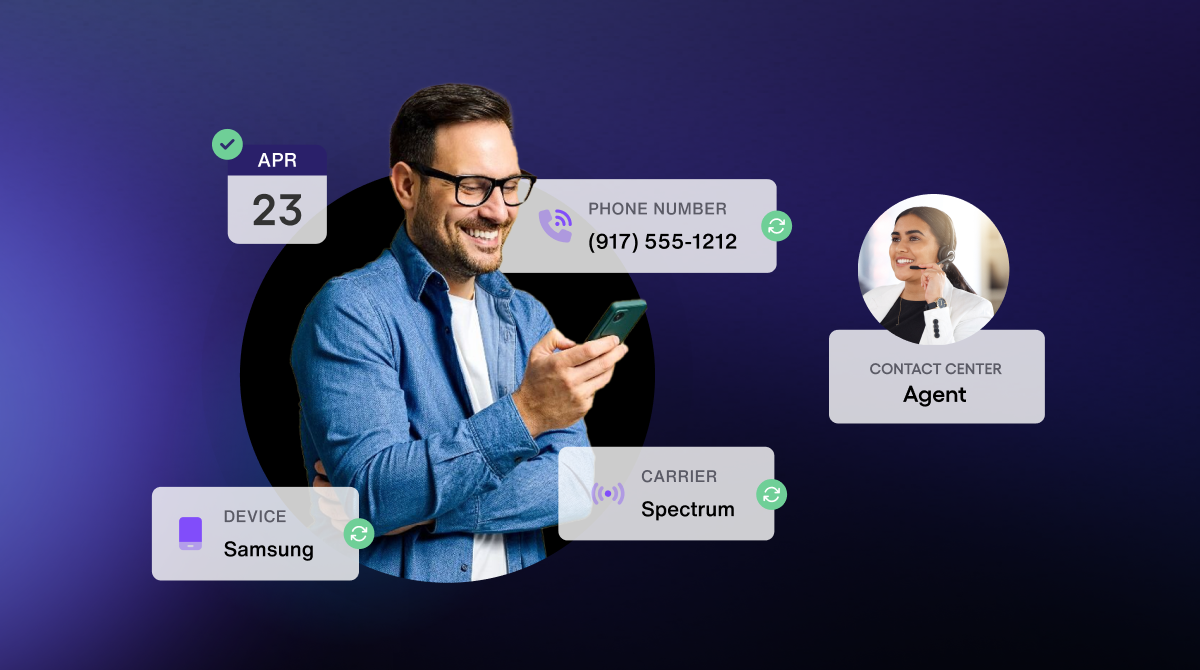
In practice, a trusted caller can be silently authenticated before they ever reach an agent. In this case, the conversation starts with, "Hello Jane, how can we help you today?, instead of a gauntlet of security questions. Higher-risk calls are seamlessly stepped up or routed for additional verification, keeping fraudsters out without punishing real customers.
Proven results in the contact center
Prove already secures identity for 2000+ enterprise clients, including 19 of the top 20 US banks, with more than 30B transactions authenticated annually. In contact center deployments, the impact is measurable:
- A global credit card issuer realized $1B in incremental revenue, $200M in OPEX savings, and a 75% reduction in fraud within their contact center.
- A Fortune 500 investment firm reduced 1,500 calls per week at an average of $7.30 per call, and prevented an account takeover attempt with roughly $7M at risk.
- A global insurance company achieved a 14% reduction in average call center handle time, a 58% increase in successful registrations, and an overall improvement in customer experience, with an 85%+ OTP success rate, up from 60% under legacy KBA.
Why it matters for banking and insurance
Whether the threat is a wire transfer redirect, a new-payee setup from a spoofed number, a card takeover, an MFA bypass, or, in the insurance business, a fraudulent policy cancellation, beneficiary change, or annuity withdrawal, the common thread is the same: a fraudster exploiting an authentication process that was never built to stop them. Prove gives agents and IVR flows the confidence to know who's really on the line before any high-stakes transaction takes place.
Get started
Witness the combined power of Amazon Connect® + Prove® and get advanced identity verification and fraud prevention for the contact center, available on the AWS Marketplace.
To learn more about how Prove for Amazon Connect can help you stop ATO fraud, reduce handle time, and delight your customers, visit our dedicated Prove for Amazon Connect webpage.
The modern
way of proving identity
Trusted by 2,000+ leading companies to reduce fraud and improve consumer


Frequently Asked Questions
Prove for Amazon Connect integrates identity verification, authentication, and fraud prevention into Amazon Connect contact center journeys.
Prove authenticates trusted callers, assesses risk in real time, detects suspicious activity, and steps up verification when needed.
Prove reduces security questions and unnecessary challenges, helping organizations shorten handle times and serve legitimate customers faster.
Keep reading
 Read the article: Still Using SMS OTP? See What It’s Really Costing Your Business
See what SMS OTP is really costing your business. Prove’s Beyond OTP Assessment measures cost, customer friction, fraud exposure, and OTP dependency, and provides a practical path toward Unified Authentication.
 Read the article: Prove Extends SIM-Based Silent Authentication to Wi-Fi and Mobile We
Prove has extended its SIM-based silent authentication technology to Wi-Fi connections and mobile web sessions, allowing supported authentication flows to verify possession of a mobile device without requiring a direct cellular data connection or an SMS one-time passcode.
 Read the article: CLARITY Act could allow 11 crypto activities for US banks
The Congressional Research Service has identified 11 categories of crypto activities that the Senate-reported CLARITY Act would permit for U.S. banking organizations and credit unions, including digital asset underwriting and dealing.


