Account Takeovers: The Silent Revenue Killer in Digital Marketplaces
What is account takeover fraud, and why are marketplaces increasingly vulnerable? Discover the financial impact of ATO attacks on gig platforms, including chargebacks, refund abuse, customer attrition, and the identity-driven strategies leading companies use to prevent fraud.



Key takeaways
- Account takeover (ATO) fraud has become a major business risk for digital marketplaces and gig platforms. Attack volumes continue to rise rapidly, with marketplaces experiencing significantly higher attack rates than many other industries, making ATO both a security and revenue challenge.
- The true cost of ATO extends far beyond direct fraud losses. Compromised accounts drive chargebacks, refund abuse, customer support costs, regulatory exposure, and customer churn, creating a much larger financial impact than most organizations currently measure.
- Credential stuffing and AI-powered social engineering are fueling the growth of ATO attacks. Password reuse, leaked credentials, phishing, SIM-swapping, and deepfake-enabled impersonation have made account compromise easier, more scalable, and more accessible to fraudsters.
- Fraud-as-a-Service has lowered the barrier to entry for cybercriminals. Ready-made fraud toolkits, phishing platforms, and generative AI tools allow even relatively unskilled attackers to launch sophisticated account takeover campaigns at scale.
- Leading organizations are shifting to identity-centric fraud prevention strategies. By combining trusted identity signals, real-time risk assessment, passive authentication, and continuous identity monitoring, businesses can reduce account takeover risk while maintaining a frictionless user experience.
There's a fraud vector quietly draining your platform's revenue, eroding hard-won customer trust, and inflating your chargeback ratios, and it may not even be appearing in your primary fraud dashboards. Account takeover (ATO) fraud has evolved into a systematic, industrialized attack on the gig economy and digital marketplace sector. If your platform facilitates interactions or transactions between two parties, ATO has become both a security and a P&L problem.
The Scale Is Bigger Than Most Platforms Admit
The numbers are staggering, and the velocity is accelerating. Global ATO volume grew 21% from H1 2024 to H1 2025, and looking back further, ATO fraud surged 141% between H1 2021 and H1 2025. That trajectory puts it in a different category from most fraud types: not a spike, but a structural climb. The FBI's Internet Crime Complaint Center (IC3) recorded $16.6 billion in total cybercrime losses in 2024, with personal data breaches and account-level fraud among the top contributing crime types.
For marketplace and gig platforms, the picture is even worse. ATO attack rates on marketplaces surged 90% year-over-year, roughly four times the cross-industry average of 24%. Nearly 83% of organizations were hit by at least one ATO attack in the past year, with 26% facing an attempt every single week. For two-sided marketplace operators, ATO is now a baseline operating condition.
Why Gig and Marketplace Platforms Are Prime Targets
ATO attackers follow value, velocity, and volume, and digital marketplaces offer all three in abundance. Your platform likely stores saved payment methods, loyalty credits, promotional balances, and trusted identity profiles, each of which represents a ready-to-exploit asset the moment a fraudster gains access. The combination of high transaction frequency, thin authentication layers, and diverse user populations makes gig and marketplace platforms a particularly attractive target.
The primary attack vector is well-documented: credential stuffing, the automated cycling of stolen username and password combinations harvested from unrelated breaches. There are more than 26 billion credential-stuffing attempts per month across the web, and that volume makes brute-force prevention essentially impossible without identity-level controls. The underlying driver is password reuse: 62% of Americans still reuse passwords across accounts, and 52% of login attempts involve leaked credentials. Put simply, your users are almost certainly reusing credentials from platforms that have already been breached.
But credential stuffing is only the entry point. Layered on top of it is a rapidly growing wave of AI-enabled social engineering. The Association of Certified Fraud Examiners (ACFE) identified ATO as one of the top-growth fraud categories of 2025, driven by the convergence of phishing, SIM-swapping, and deepfake-assisted impersonation. Fraudsters are deploying generative AI to craft hyper-personalized lures and using deepfake technology to bypass liveness detection and facial verification, all capabilities that, until recently, required significant technical sophistication.
What was once called hacking is now a productized, scalable criminal business model with a low barrier to entry and a high return on investment.
The Hidden Revenue Damage You're Probably Underreporting
Most risk teams measure ATO losses through direct fraud like stolen stored credits, unauthorized rides, fraudulent food orders. But these visible losses are only the surface. The full economic damage is significantly underreported because it cascades across multiple line items that rarely get attributed back to account compromise.
Chargebacks are the most immediate downstream consequence. When a fraudster uses a compromised account to make a purchase, the legitimate account holder files a criminal fraud chargeback, and the platform or merchant absorbs the loss. Global chargeback rates rose 8% in 2024, with dispute rates spiking 78% year-over-year in Q3. The multiplier effect is severe: for every $1 lost to chargebacks, businesses now incur $3.75 to $4.61 in total costs, a 37% increase since 2021. On gig delivery platforms the problem is particularly acute, with third-party delivery app chargeback ratios running at approximately 3%, which is roughly 20 times higher than the 0.1–0.2% industry average for direct restaurant orders.
Refund and promo abuse compounds the damage further. In one case, a single fraudster device accessed over 200 accounts, generating $5,014 in transactions while reclaiming $4,163 through fraudulent refunds, an 83% success rate that effectively delivered $5,014 worth of inventory for an $851 investment. In 2024, two individuals in France were arrested for allegedly defrauding a food delivery platform of over €2 million through systematically scaled refund abuse mechanics.
Customer lifetime value destruction is perhaps the most underappreciated line item of all. More than 80% of consumers would stop using a platform after experiencing an account takeover. Once a customer experiences ATO on your platform, the CAC you spent to acquire them is gone, along with their future spend. In a market where acquisition costs continue to climb and retention is already under pressure, this is a silent margin killer that almost never appears on a fraud loss report.
Brand and regulatory exposure is meaningful and hurts deeply. Sixty-two percent of consumers say they would be less likely, or would stop entirely, shopping with a brand after experiencing fraud. Meanwhile, 77% of U.S. data breaches in 2025 exposed full Social Security numbers, the highest rate in six years of TransUnion research, meaning the regulatory surface area attached to each ATO incident is expanding rapidly alongside the reputational risk.
The Compounding Problem: Fraud-as-a-Service Has Lowered the Barrier to Entry
What most sharply distinguishes the 2025 ATO landscape from three years ago is the democratization of the infrastructure behind them. Ready-made fraud toolkits are available on Telegram for as little as $10 per week. "Phishing as a service" (PhaaS) platforms give relatively unskilled attackers enterprise-grade capabilities at minimal cost. The ACFE's 2025 Fraud Trends Report notes that generative AI use in phishing, impersonation, and account takeover schemes saw a "marked increase" in 2024 and continued accelerating through 2025.
This normalization of fraud participation creates a distinctive supply-side problem for gig platforms. Worker-side ATO (the compromise of driver, courier, or caregiver accounts) is every bit as dangerous as consumer-side compromise, yet it receives far less attention. A hijacked driver account can reroute earnings, manipulate ratings, or facilitate collusion with fake customer accounts, creating fraud vectors that are significantly harder to detect with transaction-layer monitoring alone.
What a Modern ATO Defense Strategy Looks Like
Organizations leading in ATO prevention have moved away from reactive, rules-based detection toward a proactive, identity-driven approach. Rather than relying solely on transaction monitoring after the fact, they establish trust in the user from the very start and continuously reinforce it across the customer lifecycle. The result is stronger security paired with better user experiences, not a tradeoff between the two.
Several capabilities define this shift:
Establishing trusted identity as the foundation.
It’s time to face the facts: passwords and static PII are widely exposed and easily exploited. Stronger defenses begin with high-integrity identity signals that fraudsters cannot easily replicate at scale. Prove leverages rich, real-world signals like tenure, behavioral consistency, and device associations, to ensure there is a verified connection between this individual and their digital identity. Grounding decisions in these persistent signals dramatically raises the barrier for account takeover.
Making real-time, high-confidence decisions at critical moments.
ATO prevention requires evaluating risk precisely when it matters most: at login, during account changes, and at high-value transactions. Prove delivers a real-time assessment of identity confidence using network-level signals including SIM changes, device shifts, and number portability events, enabling businesses to detect suspicious activity such as SIM swap attempts and respond before fraud is completed. The result is faster, more accurate decisioning that protects accounts without creating friction for legitimate users.
Reducing friction with intelligent, passive authentication.
The security-versus-experience tradeoff is especially consequential for high-volume digital platforms, where even small increases in step-up authentication can meaningfully impact conversion. Prove Unified Authentication℠ addresses this by verifying returning users through cryptographic device binding and possession-based signals, silently, without interrupting the session. Trusted users move through frictionlessly; anomalous sessions trigger risk-appropriate challenges automatically.
Extending trust across the entire user ecosystem.
On marketplace and gig platforms, fraud risk exists on both sides of the transaction. High-value attacks frequently target payout changes, account updates, and device substitutions on provider accounts, yet these often receive less scrutiny than consumer-side activity. Prove Verified User℠ enables businesses to establish and maintain verified identities for all participants, ensuring that every transaction, whether initiating or fulfilling a service, is tied to a known, trusted individual.
Maintaining identity confidence throughout the customer lifecycle.
ATO rarely announces itself in a single moment. Fraudsters often gain access, lie dormant, and quietly alter account details over time before executing a high-value transaction. Prove Identity Manager℠ maintains a persistent, tokenized view of identity — tracking trusted associations and surfacing inconsistencies as they emerge — giving businesses the longitudinal visibility needed to catch suspicious behavior before the damage is done.
The Stakes Are Getting Higher
Gartner predicts that by 2028, 20% of large enterprises will operate dedicated cyber-fraud fusion teams that merge fraud prevention with cybersecurity functions, up from less than 5% today.
The organizational implication is clear: ATO can no longer be managed as a fraud ops problem with a rules engine. It demands cross-functional investment in identity intelligence and organizational alignment across trust & safety, cybersecurity, product, and finance.
The platforms that treat account integrity as a competitive differentiator — not a compliance checkbox — will be the ones that protect customer lifetime value, reduce chargeback exposure, and build the kind of durable trust that compounds into GMV growth. The ones that don't will eventually discover what many already have: ATO is very much a revenue problem. It just doesn't announce itself.
The modern
way of proving identity
Trusted by 2,000+ leading companies to reduce fraud and improve consumer


Keep reading
 Read the article: Trust at Marketplace Speed: Why Authentication Is Becoming Persistent Infrastructure
Learn why marketplace authentication must extend beyond login. Explore how persistent identity, cryptographic possession, and risk-based authentication can help marketplaces prevent account takeover, reduce friction, and maintain trust across the customer lifecycle.
 Read the article: Beyond the OTP: What’s Driving the Next Generation of Authentication in Online Gaming
Learn why online gaming authentication is moving beyond passwords, SMS OTPs, and traditional MFA toward continuous, risk-based trust. Explore how persistent identity, cryptographic possession, device and network intelligence, and adaptive authentication can help gaming operators reduce fraud while creating a more seamless player experience.
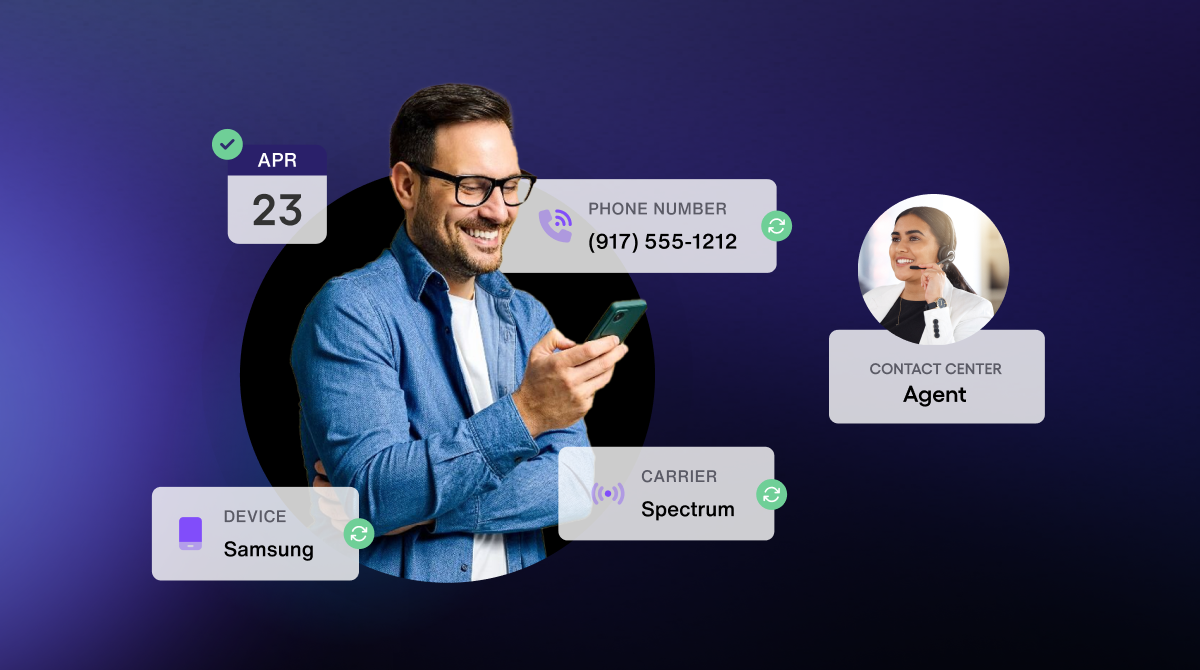 Read the article: Stop Account Takeover Fraud Without Slowing Down Real Customers in the Contact Center
Learn how Prove for Amazon Connect helps banks and insurers prevent account takeover, authenticate callers, reduce handle time, and improve customer experience.


