The Last Gap in Silent Network Authentication. Closed.
Learn how GSMA TS.43 is transforming mobile identity verification and how Prove leverages it to reduce reliance on SMS OTP while delivering stronger, device-bound authentication.



Key takeaways
- GSMA TS.43 modernizes mobile identity verification by enabling stronger, SIM-based authentication beyond SMS OTP.
- Silent Network Authentication works across more environments, including browser-based experiences on Wi-Fi.
- TS.43 reduces reliance on SMS passcodes while improving authentication speed and user experience.
- Device-bound authentication adds stronger identity protection against threats like phishing and SIM swap fraud.
- Prove integrates TS.43 into its authentication platform to help enterprises deliver seamless, secure identity verification.
Prove is bringing TS.43 to our global platform. Here's what that means for the future of authentication.
But the nature of risk has changed. A lot. Regulators around the globe are phasing out SMS-based authentication for high-risk financial services because of concerns about fraud, SIM swaps, and phishing attacks. As a result, the industry has been looking for a stronger, more seamless way to verify identity.
What Is TS.43 and What Does It Solve?
GSMA TS.43 Release 11 is a new standard that extends SIM and eSIM-based authentication across any network type, with consent-based access for third-party apps and services. For identity, that extension matters.
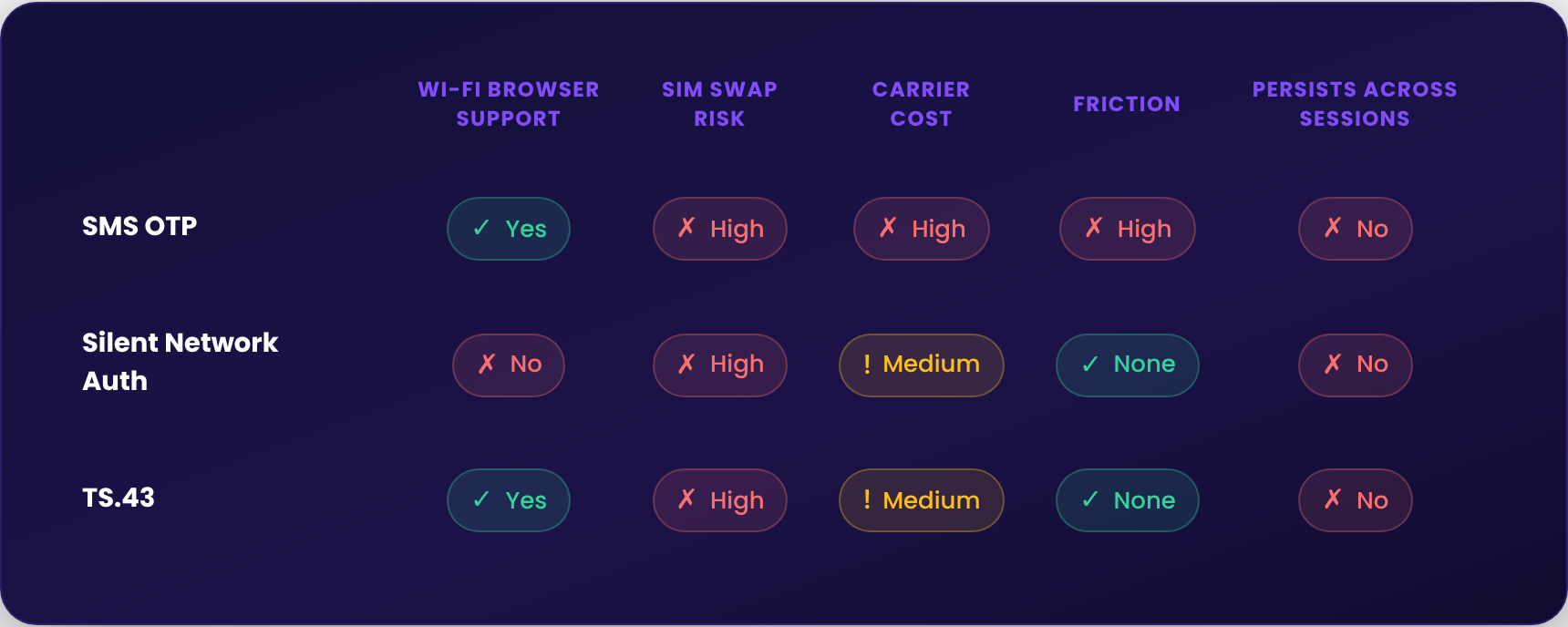
Silent network authentication (SNA) has always had a hard limit. It works in apps on cellular or Wi-Fi, but the moment a user switches to a browser on Wi-Fi, it fails. For many enterprises that's not an edge case, it's a significant share of sessions. TS.43 closes that gap by moving authentication to the SIM card itself, cryptographic, hardware-backed, independent of connection type. Everywhere SNA already works, plus the one place it never could: a browser on Wi-Fi.
That matters. But it's worth understanding why carriers are pushing it.
SMS OTP is a roughly $10 billion annual business for mobile operators, under pressure from fraud, regulation, and enterprise migration toward passkeys and app-based flows. Estimates suggest a quarter of that revenue is tied to fraudulent traffic. TS.43 is carriers' answer: modernize authentication, defend their role in the identity stack, replace declining OTP revenue with a new transaction type. Enterprises should expect pricing comparable to what they pay for OTP today. This is a business move as much as a technical one.
And it still has two unresolved problems. First, SIM swap. TS.43 authenticates the SIM, not the person. Swap the SIM and you've defeated it, the same root vulnerability that made OTP untenable. Second, cost and complexity. TS.43 is still a carrier transaction, the spend changes shape, it doesn't disappear.
How Prove Is Building TS.43 Into Its Platform
Prove is integrating TS.43 into Prove Mobile Auth and Prove Unified Authentication solutions. Existing clients won't change a thing, no new carrier contracts, no integration project, no OEM certification cycles. It will simply be available, rolling out globally as carrier infrastructure matures.
There is one area that requires care. TS.43 mandates carrier by carrier end user consent. Done poorly, a clunky or confusing consent experience will erode consumer trust and kill conversion before authentication even runs. Prove manages that consent layer on behalf of clients, handling the variation across carriers, markets, and regulatory requirements so the experience stays seamless and adoption stays high.
TS.43 is a better signal. The Prove Key is where identity lives.
Once identity is established, using TS.43, OTP, or whatever the user consents to, we bind it to the device cryptographically. Not the SIM. The device. Rooted in years of longitudinal signals that no session level credential can replicate. A SIM swap doesn't touch it. And because trust persists across sessions, the carrier transaction doesn't repeat. Clients on Prove's platform have cut SMS OTP costs by 50% without touching their security posture.
Extending SNA Beyond Its Legacy Limits
Prove's north star is simple: a world where consumers never have to think about security. No codes. No friction. No vulnerability. Just persistent, always-on identity that works in the background, so every digital transaction is protected without the person ever knowing it happened.
Every capability we add moves us closer to that. The latest is closing the last gap in silent network authentication.
That limit is now gone.
TS.43 brings silent, cryptographic, hardware-backed authentication to every session, regardless of how the device connects. Browser or app. Cellular or Wi-Fi. It works everywhere SNA already does, plus the one place it never could.
And two problems remain unresolved. First, SIM swap. The new standard authenticates the SIM, not the person. Swap the SIM and you've defeated it, the same root vulnerability that made OTP untenable. Second, cost. It's still a carrier transaction. The spend changes shape, it doesn't disappear.
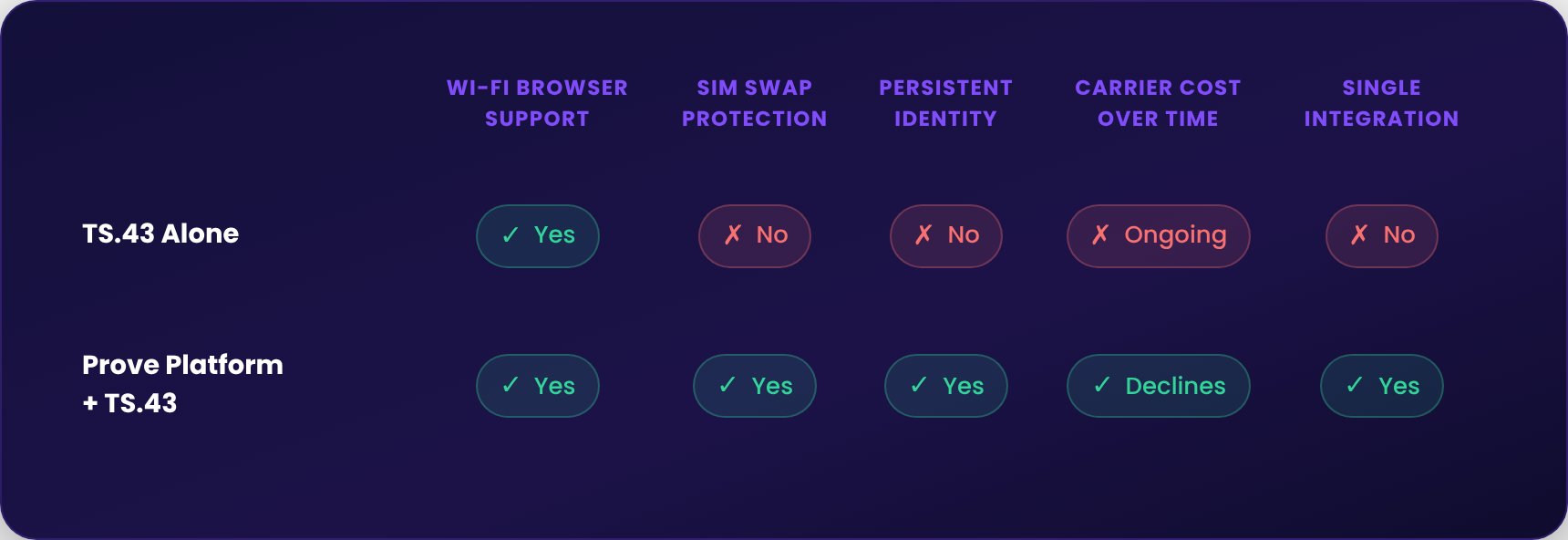
Every new standard gets evaluated the same way: does it improve experience, reduce fraud, lower cost, simultaneously, without sacrifice? TS.43 earns its place. Prove makes it better.
TS.43 verifies the SIM. Prove verifies the person, with years of longitudinal identity signals behind every answer. That's the difference between a check and a conviction.
The modern
way of proving identity
Trusted by 2,000+ leading companies to reduce fraud and improve consumer


Frequently Asked Questions
A mobile identity standard that enables secure, consent-based authentication using SIM and eSIM capabilities.
It extends silent network authentication beyond traditional mobile app experiences, including browser sessions over Wi-Fi.
TS.43 uses hardware-backed mobile authentication instead of relying on texted passcodes that can be exposed to fraud.
Bill Fish is the VP of Authentication at Prove, building new solutions that help customers confidently and simply authenticate their users. He previously spent over 10 years at Verizon, building products in communication, data privacy, identity and authentication for the Consumer Group with a focus on improving customer experience.
Keep reading
 Read the article: The Contact Center Has Become Banking’s Identity Blind Spot
Learn how banks can modernize contact center authentication to prevent account takeover, reduce fraud and costs, and improve customer experience with stronger identity intelligence.
 Read the article: How Public SMS Numbers Undermine OTP Verification
Public SMS numbers can bypass basic OTP verification and expose onboarding flows to fraud. Learn why OTP alone isn’t enough and how layered identity and risk signals can help.
 Read the article: Trust at Marketplace Speed: Why Authentication Is Becoming Persistent Infrastructure
Learn why marketplace authentication must extend beyond login. Explore how persistent identity, cryptographic possession, and risk-based authentication can help marketplaces prevent account takeover, reduce friction, and maintain trust across the customer lifecycle.


