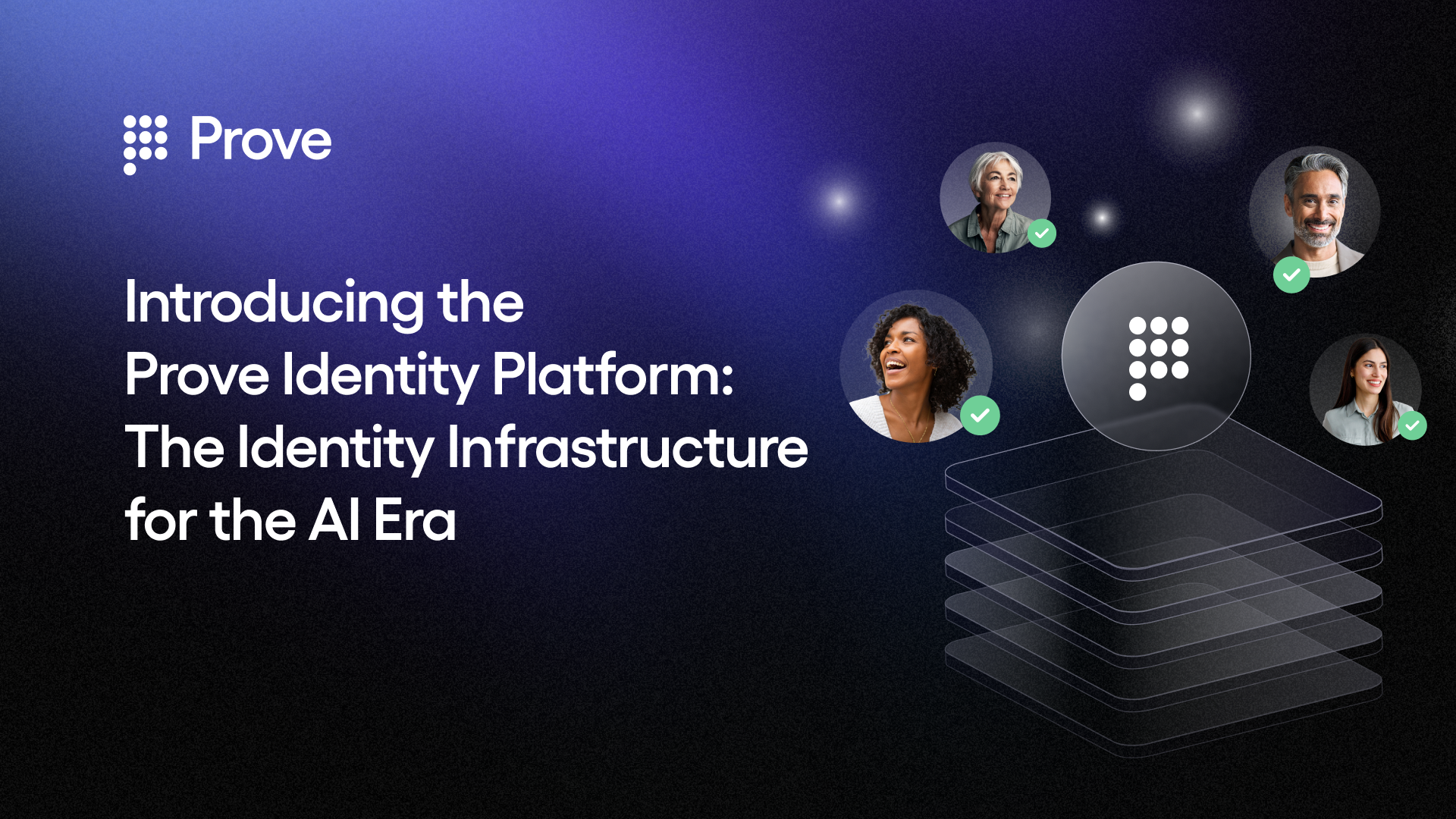
Introducing the Prove Identity Platform: The Identity Infrastructure for the AI Era
Learn how the Prove Identity Platform delivers unified identity infrastructure for the AI era — replacing fragmented verification, authentication, and fraud tools with one persistent, connected system.

For the past decade, digital identity has been built on a flawed assumption: that trust can be established at a single moment in time.
Verify a user at onboarding. Authenticate them at login. Score risk at the transaction.
The presumption has been that this could be achieved in a detached model, where different sets of data, systems, and definitions of identity could be utilized independently to verify an identity.
But that model is now woefully outdated and incapable of performing the primary tasks required of an identity verification process. AI has fundamentally changed both sides of the equation. Attackers can generate synthetic identities that persist and evolve. Bots no longer behave like bots. And fraud is no longer a point-in-time event; it is continuous, adaptive, and designed to exploit the gaps between systems.
At the same time, customer expectations have evolved. The new baseline is focused on speed and delivery of immediate value. Users abandon processes that they perceive as onerous or unnecessary. Every additional friction point directly impacts conversion, retention, and revenue. And the challenge is only intensifying: AI has driven the cost of impersonation to zero, while AI agents are already initiating real transactions on behalf of real people, creating an environment where organizations must verify not just customers, but every human, business, and agent acting within their ecosystem.
This leaves organizations in a bind: the more fragmented the identity stack — verification at onboarding, authentication at login, fraud monitoring through separate systems that never share context — the harder it is to stop fraud and the harder it is to deliver a seamless experience. Every handoff is a gap. Every gap is a risk.
What’s required is a shift from point-in-time identity checks to persistent identity infrastructure.
Today, Prove is addressing this shift by introducing the Prove Identity PlatformSM, a unified foundation that allows organizations to establish, maintain, and continuously strengthen trust in a user’s identity across the entire lifecycle.
Powered by secure tokenization, the Prove Identity PlatformSM delivers a growing suite of new and enhanced solutions to more accurately verify identities, prevent fraud, and remove friction for the world’s leading brands. Prove solutions are now built on three core platform components for adaptive authentication, advanced fraud protection, and proactive identity monitoring across the entire customer journey. All are auto-enabled and embedded into Prove’s solutions by default.
The platform operates with these key pillars:
- Adaptive Authentication: Prove Key Management anchors identity by securely binding cryptographic keys to devices. Through intelligent orchestration authentication methods, Prove enables seamless, low-friction user experiences while strengthening security and reducing fraud risk. The result is adaptive, future-proof authentication that meets stringent regulatory requirements across industries—without compromising speed, scale, or customer trust.
- Advanced Fraud Protection: Prove Global Fraud Policy is a comprehensive set of business intelligence for combating fraud. The GFP translates collaborative intelligence from Prove’s data and real-world fraud insights from our customers into a unified output. The GFP automatically adapts to new fraud patterns, compounds value over time, and uses connected signals and network intelligence to see more risk, stop more fraud, and create less friction than competing solutions.
- Proactive Identity Monitoring: Prove Identity Manager consolidates fragmented account data into a single, trusted identity enabling unmatched identity data intelligence. Through continuous, active monitoring and real-time alerts linked to each customer’s Prove ID, including alerts on key lifecycle changes such as device, phone number, or carrier updates, we ensure database integrity, unlock deep personalization, and elevate the overall customer experience.
How the Prove Identity Platform Drives Better Identity Outcomes
To help organizations meet these evolving challenges, the Prove Identity Platform delivers a unified approach to identity that strengthens trust, reduces friction, and improves performance across the entire customer lifecycle. The benefits of this platform extend beyond individual point solutions, creating compounding value through a connected, persistent identity framework. Key benefits include the ability to do the following:
- Increase pass rates by 20% compared to Risk-Based Authentication
- Reduce friction and cost while improving accuracy compared to document verification
- Enable global coverage to help you verify, authenticate, and protect customers anywhere in the world
- Build on a Trusted Identity Foundation to verify more real users, stop more fraud, and reduce friction
- Scale seamlessly by implementing the platform once, then activating additional solutions as your needs evolve
- Unlock reliable results at scale with consistent performance across channels and markets, with automatic upgrades to the latest fraud and security innovations
The Identity Infrastructure for the AI Economy
The Prove Identity Platform gives companies a unified set of identity capabilities that function seamlessly to verify users, detect fraud, and authenticate customers with minimal friction. Prove solutions are organized around the three stages of the customer lifecycle:
- Grow: Unlock new identity-powered experiences and services.
- Welcome: Acquire and onboard trusted users.
- Know: Continuously verify and authenticate customers.
Each stage is powered by a suite of solutions that share, and orchestrate, the same identity infrastructure, signals, and intelligence.
One Platform, One Identity System
The Prove Identity Platform operates as a single identity system designed to operate across the entire customer lifecycle, and every solution across Welcome, Know, and Grow, is built on the same underlying foundation:
Welcome
- Prove Human Assurance: Validates human presence at the authenticator level using identity signals tied to a real, phone-tenured individual, blocking bots, SMS pumping attacks, and automated account abuse before they reach your application layer.
- Prove Account Opening: Leverages phone number intelligence and identity graph data to verify and activate new users in real time with minimal input, establishing identity trust at account creation rather than layering on post-onboarding checks.
- Prove Pre-Fill® for Consumer: Uses phone-centric identity signals to pre-populate application fields with verified consumer data, cutting onboarding drop-off while reducing synthetic identity and first-party fraud risk. Supports optional KYC orchestration.
- Prove Pre-Fill® for Business: Extends phone-based identity verification to business onboarding by linking an individual applicant to a business entity, minimizing manual data entry without loosening identity assurance standards.
Know
- Prove Verified User: Continuously associates platform accounts with verified, phone-tenured identities, providing a persistent trust signal that helps detect impersonators, synthetic accounts, and bot-driven activity at scale.
- Prove Unified Authentication: Orchestrates authentication across the user lifecycle using possession- and identity-based signals, reducing reliance on SMS OTP while maintaining a consistent, step-up-capable trust posture across sessions.
- Know Your Payee: Verifies the identity of payment recipients prior to fund disbursement, helping financial institutions reduce authorized push payment fraud and misdirected transfers across ACH, RTP, and other payment rails.
Grow
- ProveX: A data exchange layer that gives partners access to Prove's verified identity credentials, enabling downstream use cases like streamlined onboarding, identity-linked personalization, and trust signal sharing across ecosystems.
Individually, each solution that runs on the Prove Identity Platform solves critical problems: stopping bots, improving onboarding conversion, strengthening authentication, preventing payment fraud.
The real impact comes from how these capabilities work together:
- A persistent identity layer that enables trusted user recognition
- A shared intelligence network that continuously refines identity confidence
- A unified risk model that applies consistent decisioning across use cases
- A common integration layer that eliminates the need for disconnected systems
This is what allows identity to function as a continuous thread rather than a series of disconnected events. Consider what this can deliver:
- An onboarding decision informs authentication.
- An authentication event strengthens future risk evaluation.
- A payment interaction benefits from everything known about the user beforehand.
Nothing is lost between steps. Nothing needs to be reassembled.
For organizations, this fundamentally changes how identity is implemented and operated. Instead of stitching together multiple vendors, they can deploy a single, unified platform. Rather than duplicating data and logic across systems, they operate from a shared source of truth. And instead of reacting to fraud at individual touchpoints, they are able to manage risk holistically across the entire customer lifecycle.
The result is consistency across all of them. And in a world where fraud exploits fragmentation and customers experience every gap, that consistency is what ultimately determines both security and user experience.
The modern
way of proving identity
Trusted by 2,000+ leading companies to reduce fraud and improve consumer


Keep reading
 Read the article: Prove Unveils Inaugural Trust 25 Honoring Leaders from Citi, Bank of America, and Uber
Prove has launched the Trust 25, an inaugural recognition program for 25 executives from top firms like Citi and Uber who are advancing digital identity and fraud prevention in the AI era.
 Read the article: Prove Unveils The Trust 25, Recognizing Leaders From Uber, Citi, PayPal, Visa, and 20+ Other Organizations Solving the Hardest Problems in Digital Identity
Prove announces the 2026 Trust 25, honoring 25 leaders from Uber, Citi, PayPal, Visa and more advancing digital identity, fraud prevention and AI-driven trust.
 Read the article: Prove Unveils The Trust 25, Recognizing Leaders From Uber, Citi, PayPal, Visa, and 20+ Other Organizations Solving the Hardest Problems in Digital Identity
Honorees span banking, payments, gaming, and technology, reflecting the breadth of industries now confronting AI-driven fraud, authentication, and the rise of AI agents


