The Crisis of Identity, Part 2: From Human Identity to Agent Authority with the Prove Identity Graph
Explore how the Prove Identity Graph extends verified human identity to securely authorize AI agents through device-bound cryptographic trust and a reusable identity passport that enables safe, scalable agentic commerce.

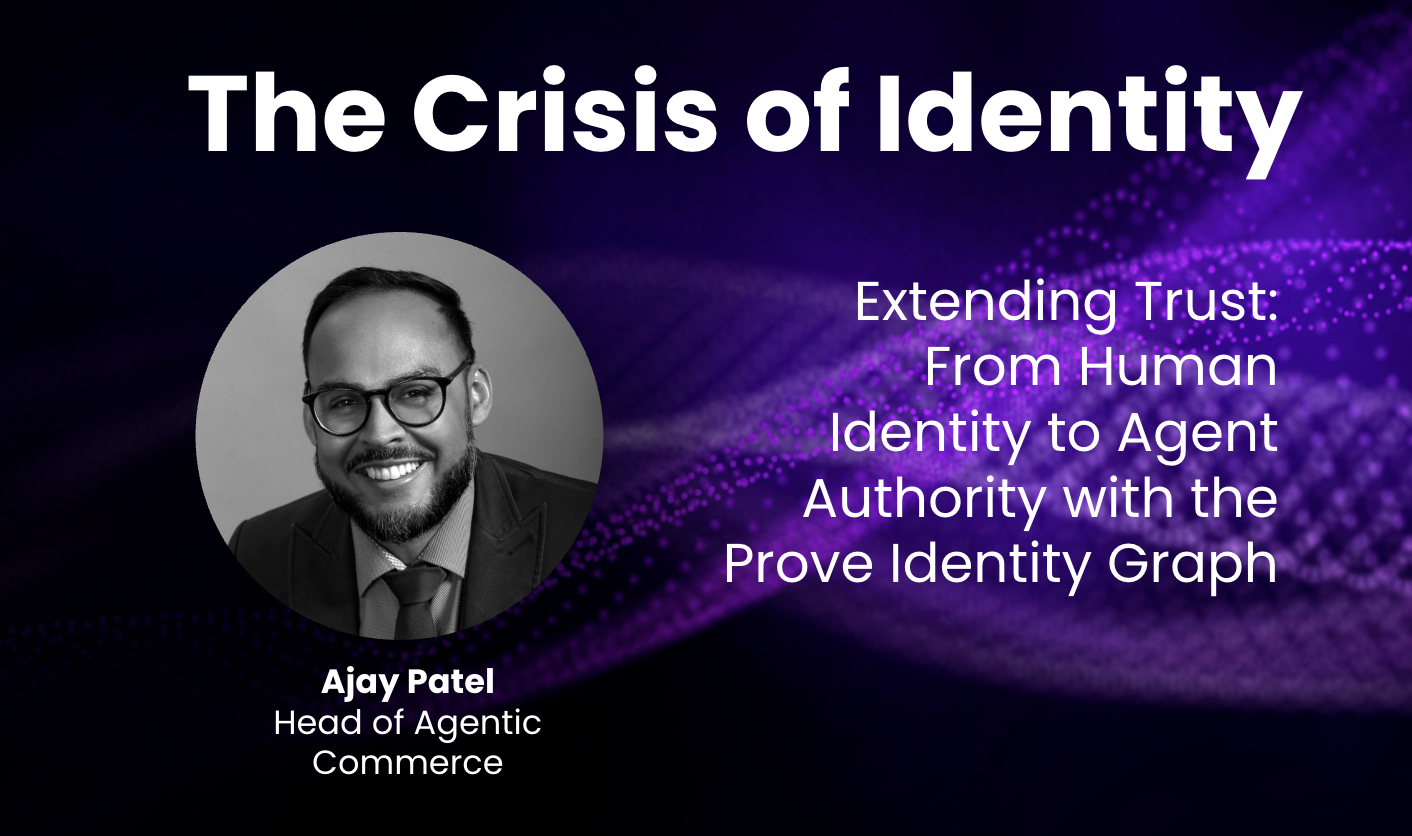
Agentic commerce cannot be secured by starting with the agent. The trust component starts much before this, and involves the verified human who gives the agent its mandate and the device that anchors that human’s digital presence.
Before an agent can be trusted to execute any operation, the underlying human identity must be verified, the device must be authenticated, and a cryptographic binding must be established that defines the agent’s permissible scope of action. This binding is not created passively; the user must actively perform the authorization steps that configure how the agent is allowed to operate, what capabilities it inherits, and the conditions under which those capabilities remain valid. This explicit, identity-anchored delegation is rooted in authenticated user intent and enforced through device-bound cryptographic controls. It is the architectural prerequisite for any agentic ecosystem that aims to be secure, auditable, and reliable at scale.
Modern organizations now need an identity strategy that reflects this shift. It’s no longer sufficient to authenticate only the human at the entry point; trust must extend outward to every agent acting on that human’s behalf. This new direction in digital identity verification becomes a critical maturity extension of existing identity frameworks into the agent domain and is supported by the Prove Identity Graph. It uses continuously orchestrated data, collected over 10 years, from 10 billion devices and 2.5 billion verified identities, to deliver continuous, real-time identity validation that’s necessary to evolve from human-centric authentication to a model that also governs agent authority. That infrastructure is becoming the base layer that allows agents to operate safely, inherit human-derived trust, and participate in commerce with the same level of security and accountability.
From Human Identity to Agent Authority
The shift from human-only interactions to agent-mediated interactions requires a reframing of organizational identity strategy. Identity must now operate on two planes simultaneously, and in a persistent way:
- Human Identity: verifying who the person is, ensuring the legitimacy of their device, and establishing trust for every session.
- Agent Authority: confirming which agents are acting on behalf of that person, what scope of permission they hold, and whether each action is actually authorized.
The Prove Identity Graph provides the connective tissue between these two planes. It extends trust from the human to their agents, giving organizations a way to maintain continuity between the person, their devices, their agents, and the merchants they interact with. This continuous verifiable chain of custody is what changes the agent dynamic from just being convenient, to being safe.
The Reusable Identity Passport: The Cryptographic Bridge
At the technical core of the foundational layer is a reusable identity passport, which operates as a persistent trust artifact generated only after a human identity has been verified and bound to an authenticated device. The passport is a durable, replay-safe container for that binding. It encapsulates the cryptographic relationship between a verified person and the device keys used to represent them, forming a stable identity anchor that downstream systems can reliably consume.
The passport should be understood as a portable, continuously validated identity token; it is not a static credential. Unlike one-time authentication events, the passport persists across merchants, channels, and agent environments while remaining tightly coupled to real-time signals from the Prove Identity Graph. This means the Passport can be reused silently within workflows without triggering repeated user authentication steps, because trust is maintained through ongoing device-identity correlation rather than stored secrets or brittle session tokens.
In agentic contexts, the passport becomes the authorization substrate. Every agent request can be evaluated as a signed, verifiable event that originates from a known identity anchored to a known device, with the Passport providing the cryptographic linkage. This allows organizations to enforce agent authority not by relying on standalone keys, user-managed wallets, or ad hoc delegation models, but by inheriting the assurance of a continuously validated identity-device relationship.
The practical effect is that the passport shifts trust from: “Who generated this key?”...to: “Which verified human and device does this action ultimately represent, AND is that relationship still valid right now?”
This is the mechanism that makes agent authority enforceable at scale: a living, graph-backed trust token that provides strong guarantees about provenance, continuity, and authenticity across agent interactions.
A Thin, Lightweight, Developer-Ready Base Layer
The identity layer required for agentic commerce must operate as minimal infrastructure; it should be thin, lightweight, and deployable with the same ease as an API call. The primary design constraint is non-intrusion: developers should not have to rework authentication flows, modify UI, or introduce new user obligations just to support agent authority. The trust framework must integrate into existing stacks the way TLS integrates into HTTP. In other words, it needs to be present, and essential, but not disruptive.
Prove’s architecture is built around this principle. The system provides a set of authentication-backed guarantees that can secure any adult human with a device to any merchant endpoint with near-zero friction. The value is in what developers don’t see. Trust is established and maintained through invisible, real-time correlation signals and device-identity bindings sourced from the Prove Identity Graph. These signals update silently and continuously, allowing organizations to anchor sessions, agents, and transactions without creating new user touchpoints or dependency chains.
This thin base layer is why large wallets, payment platforms, and high-volume commerce systems use Prove as the secure wrapper around their end-to-end flows. They aren’t looking for pre-fill or onboarding niceties; they’re looking for a verifiable, low-latency assertion that a request is originating from “this person, on this device, right now.” Prove supplies that connective tissue, providing cryptographic assurance at the edge of every interaction and extending those assurances seamlessly into agentic workloads.
In practical terms, this means developers can treat Prove as a modular trust primitive: a minimal infrastructural component that verifies human identity, device authenticity, and session integrity, while remaining transparent to end users and lightweight for engineering teams. It is the authentication substrate that makes more complex agent architectures possible without adding new layers of operational overhead.
Silent Scale: The Prerequisite for Agentic Trust
The power of the Prove Identity Graph comes from its scale and its silence. More than 2.5 billion people and 10 billion devices can be connected to merchants with instant, cryptographically validated assurance because the components required for that validation are already in place. This silent scale is what allows Prove Verified Agent to function as the foundational KYA layer: when a person delegates authority to an agent, the trust infrastructure is already there, ready to validate identity, bind devices, and authorize the agent’s scope of action.
Building the Foundation of the Agent Economy
This part of the agentic trust stack is ultimately about the necessity of getting the foundation right. Before we talk about delegation protocols, agent capabilities, or interoperable standards, we have to establish the authentication and identity layer that everything else depends on. This is the “know” layer. It is the part that proves authenticity in every agentic session and ensures that all higher-order capabilities inherit real trust.
The modern
way of proving identity
Trusted by 2,000+ leading companies to reduce fraud and improve consumer


Keep reading
 Read the article: Prove Unveils Inaugural Trust 25 Honoring Leaders from Citi, Bank of America, and Uber
Prove has launched the Trust 25, an inaugural recognition program for 25 executives from top firms like Citi and Uber who are advancing digital identity and fraud prevention in the AI era.
 Read the article: Prove Unveils The Trust 25, Recognizing Leaders From Uber, Citi, PayPal, Visa, and 20+ Other Organizations Solving the Hardest Problems in Digital Identity
Prove announces the 2026 Trust 25, honoring 25 leaders from Uber, Citi, PayPal, Visa and more advancing digital identity, fraud prevention and AI-driven trust.
 Read the article: Prove Unveils The Trust 25, Recognizing Leaders From Uber, Citi, PayPal, Visa, and 20+ Other Organizations Solving the Hardest Problems in Digital Identity
Honorees span banking, payments, gaming, and technology, reflecting the breadth of industries now confronting AI-driven fraud, authentication, and the rise of AI agents


