Trust at Marketplace Speed: Why Authentication Is Becoming Persistent Infrastructure
Learn why marketplace authentication must extend beyond login. Explore how persistent identity, cryptographic possession, and risk-based authentication can help marketplaces prevent account takeover, reduce friction, and maintain trust across the customer lifecycle.



Key takeaways
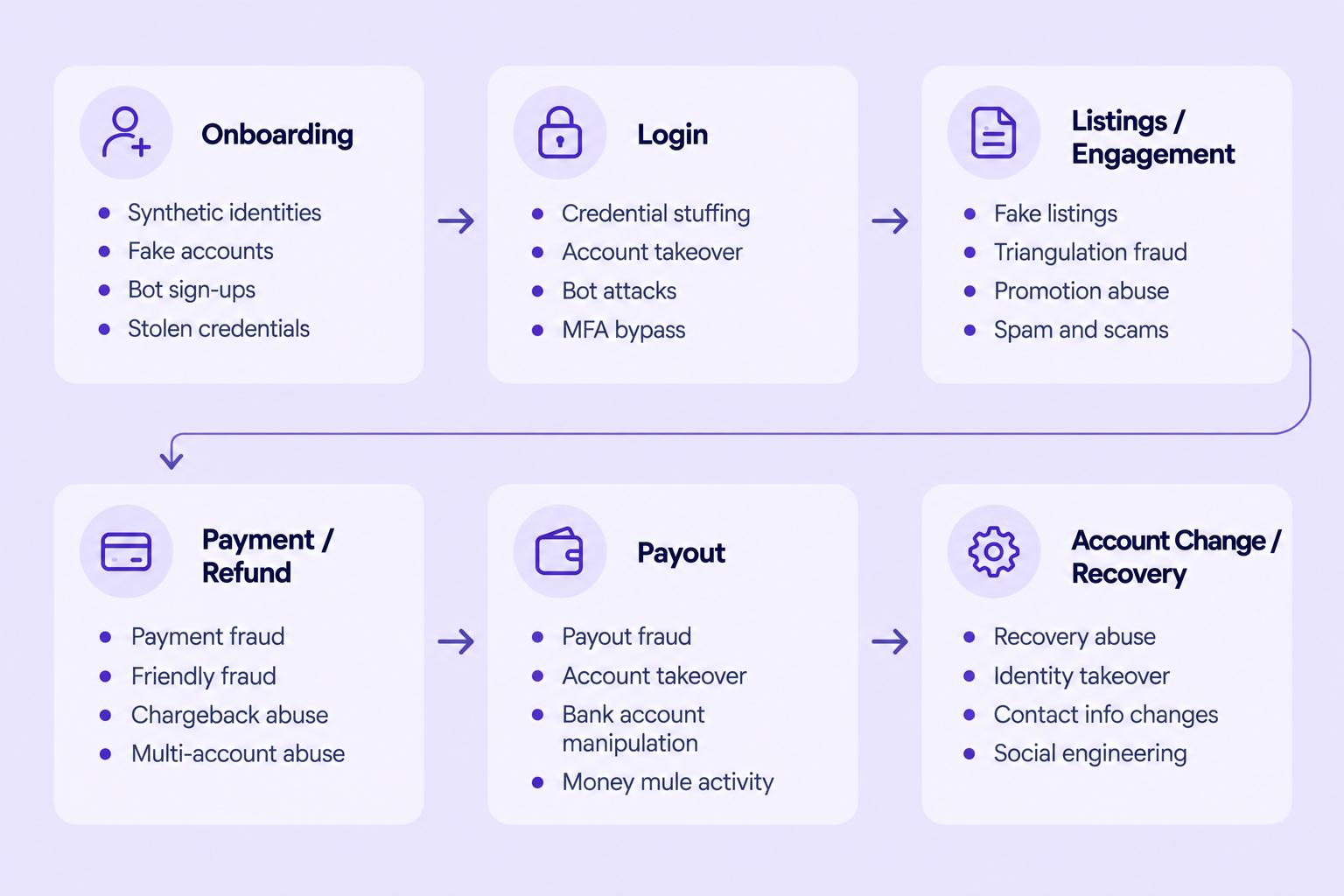
- Marketplace authentication must extend beyond login. Fraud moves across onboarding, account access, listings, payments, payouts, account changes, and recovery, making point-in-time authentication insufficient.
- Persistent context strengthens authentication decisions. Device, identity, network, possession, and historical signals help determine whether the trusted participant still controls the account.
- Cryptographic possession provides a stronger trust anchor. Device-bound keys are harder to phish, relay, or socially engineer than transferable credentials such as passwords and OTPs.
- Authentication should be orchestrated according to risk. Prove Unified Authentication℠ prioritizes strong, low-friction signals and introduces step-up authentication when context changes or additional confidence is required.
- Better authentication improves marketplace economics. Reducing unnecessary OTPs and challenges can lower authentication costs and friction while protecting the trusted relationships that drive marketplace activity.
Marketplace fraud increasingly exploits the gaps after identity verification and login: account takeover, payout changes, account recovery, promotion abuse, and compromised high-reputation accounts. The Prove State of Identity Report 2026 shows how significant those gaps have become:
- 68% of organizations lack continuous authentication across the user journey.
- 70% lack the behavioral or device intelligence needed to detect anomalies after login.
- 62% report material problems with MFA bypassing.
- 76% report increasing fraud volumes driven by automation.
- 69% say AI-driven attacks are outpacing legacy defenses.
The architectural problem is straightforward: point-in-time authentication produces point-in-time trust. Marketplaces need persistent authentication infrastructure that can recognize trusted devices, establish cryptographic possession, evaluate device, network, identity, and risk signals, and adapt authentication when context changes. The objective, however, is not more authentication. Marketplaces now require better evidence of who controls the account at the moment that matters.
Marketplaces are multi-sided identity systems
A marketplace has to secure all sides of the transaction, and the relationship between them. That expands the identity perimeter far beyond onboarding and login. Fraud can move across buyer accounts, seller accounts, listings, payments, payouts, refunds, account changes, messaging, and recovery, while established accounts accumulate the reputation and transaction history that make them increasingly valuable takeover targets. Prove’s marketplace research identifies account takeover (ATO), fake accounts, bot activity, payment fraud, promo abuse, fake listings, and identity fraud as core risks across these environments.
The attack environment is also becoming more automated and synthetic:
- 300% growth in deepfake identity attacks.
- 85% of identity fraud now involves GenAI.
- $18.4B in projected fraud losses in 2026.
- 35–36% of marketplace fraud is now attributed to first-party/chargeback fraud in Prove’s marketplace analysis.
- Credential stuffing alone generates tens of billions of automated login attempts every month across the internet, feeding ATO and account abuse at scale.
The implication is that an identity state has to persist across the transaction lifecycle. A successful onboarding check says little about who controls the account during a later payout change, recovery event, or high-risk transaction. Point solutions around KYC, login, bot detection, and payments can each work independently while still leaving exploitable gaps between them. Prove’s marketplace framework therefore emphasizes passive verification signals, risk-based authentication, and continuous monitoring instead of repeatedly re-establishing trust from scratch.
Authentication is a unit-economics problem
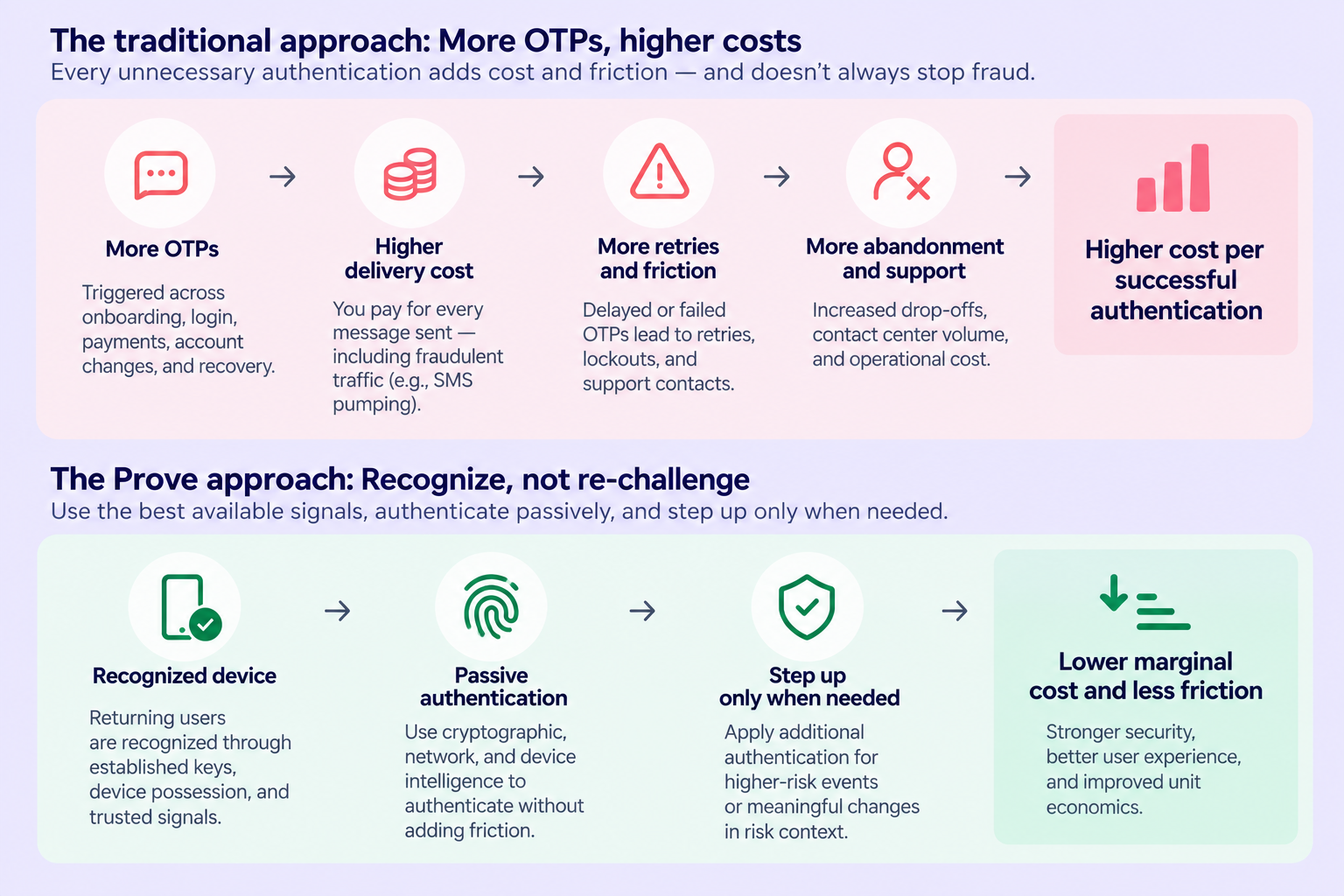
For marketplaces, every authentication event has a cost: message fees, retries, abandonment, support, fraud operations, and lost conversion. SMS OTP makes that cost especially visible because the platform pays when the message is sent, even when no legitimate user is behind the request. Prove’s marketplace research notes that SMS pumping can target registration, login, and phone-change endpoints specifically to generate OTP traffic at the marketplace’s expense.
The economic impact extends well beyond the SMS fee:
- Every OTP, retry, and step-up adds variable cost as marketplace volume scales.
- Failed or delayed OTPs can drive abandonment across login, onboarding, payments, and servicing.
- Bots and SMS pumping consume authentication budget without generating transactions or revenue.
- Retries, lockouts, support contacts, investigations, and vendor management add operating expense beyond delivery costs.
Authentication teams should rethink the optimization problem and ask, “Which authentication events were actually necessary?” If a returning participant can be authenticated through an established key, device possession, or another high-confidence signal, sending an OTP can add both cost and friction without materially improving the decision. Unified Authentication shifts the architecture toward passive authentication by default and step-up when needed, reducing routine OTP dependence while preserving stronger controls for higher-risk events.
Cryptographic possession creates a stronger trust anchor
Passwords prove knowledge. OTPs prove temporary access to a channel. Device-bound cryptographic keys prove possession of a bound authenticator without transmitting the private key. That makes possession significantly harder to phish, relay, or socially engineer than transferable credentials.
For marketplaces, possession becomes more powerful when combined with persistent context: Is this the expected device? Is the device-account relationship established? Has anything changed? What action is being attempted? Authentication becomes a multi-signal policy decision rather than the result of a single challenge.
Unified Authentication orchestrates the strongest available signals
Prove Unified Authentication℠ evaluates the strongest available authentication signals first, including Prove Key and Mobile Auth, alongside risk intelligence from Global Fraud Policy. When the available evidence is sufficient, authentication can occur passively. When it is not, the flow can step up to another method and establish stronger device binding for future interactions.
This is an important distinction because marketplace risk is highly contextual. A returning user on a recognized device is fundamentally different from a seller changing a payout account or recovering an account from a new device. The objective is not maximum authentication everywhere. It is the right authentication for the risk of the event.
Persistent identity allows trust to accumulate
Marketplace authentication should not start from zero every session. Identity, device, account, and authentication history can provide increasingly useful context as the relationship matures.
Marketplaces already apply this principle to reputation: sellers accumulate ratings, buyers build transaction histories, drivers complete trips, and hosts earn reviews. Authentication can benefit from the same concept. A legitimate participant may establish months or years of device and identity continuity; an attacker taking over the account may have the credential, but not that history.
That distinction becomes more valuable as AI makes point-in-time impersonation cheaper. Credentials can be stolen, attributes can be spoofed, and accumulated trust is harder to manufacture.
Continuous authentication can increase liquidity rather than suppress it
This is why "continuous authentication" should not be interpreted as continuously interrupting marketplace participants. Properly implemented, it means continuously maintaining enough identity context to know when interruption is unnecessary. The State of Identity Report argues that risk-adaptive identity should escalate when signals degrade while maintaining low friction when trust remains strong. For marketplaces, that principle is not merely a security improvement; it aligns authentication architecture with marketplace economics.
Consider a seller who has operated from a recognized device for months. Requiring an SMS OTP every time that seller accesses the marketplace adds repeated cost and friction despite a substantial body of existing trust evidence. Passive cryptographic authentication can allow that interaction to occur in the background. If the same seller suddenly appears from a new device and attempts to replace the payout account, however, the risk profile changes. Persistent authentication makes it possible to recognize that difference and increase assurance accordingly.
The result is a fundamentally different relationship between security and customer experience. Instead of treating friction as the mechanism through which security is created, the marketplace improves security by increasing the quality and continuity of the evidence available to its decisioning systems. Strong trust produces less friction. Degraded or insufficient trust produces proportionate step-up. Authentication becomes adaptive rather than universal.
Authentication becomes part of the marketplace trust layer
Authentication is increasingly less a login function and more core marketplace infrastructure. Once a participant has been verified, the platform needs to maintain confidence that the trusted user still controls the account as they move through transactions, payouts, account changes, and recovery. Prove Verified User℠ helps establish and persist verified identity, while Unified Authentication℠ extends that trust into account access and lifecycle events.
The architecture is straightforward: cryptographic possession establishes control, persistent identity provides history, risk intelligence adds context, and orchestration determines when additional authentication is necessary. The result is stronger protection at consequential moments without repeatedly challenging legitimate users.
For marketplaces, that is the shift that matters: from authenticating transactions to maintaining trust across the relationship. As fraud becomes faster, more automated, and better at exploiting gaps between identity systems, authentication must operate at marketplace speed, continuously protecting trusted relationships while allowing legitimate activity to keep moving.
The modern
way of proving identity
Trusted by 2,000+ leading companies to reduce fraud and improve consumer


Frequently Asked Questions
Marketplaces operate multi-sided ecosystems in which buyers, sellers, providers, and other participants interact with one another. Fraud against one account can therefore affect many other participants, and trust must be maintained across listings, messages, payments, payouts, account changes, and recovery rather than simply at checkout.
Persistent authentication maintains trusted context about the relationship among an identity, account, device, and authentication history across interactions. Rather than treating each login as an entirely new proof event, it uses that context to determine whether the current interaction remains consistent with the trusted user.
occur passively rather than requiring the user to enter an OTP or complete another visible challenge. Step-up is reserved for situations where the available evidence or risk of the action requires additional assurance.
ATO often involves a change in control of an otherwise legitimate account. Persistent authentication can help identify discrepancies between the established identity/device relationship and the current interaction, while cryptographic possession provides stronger evidence than credentials that can be phished or intercepted.
Authentication friction can interrupt the transactions and interactions that create marketplace value. Risk-adaptive authentication allows marketplaces to maintain stronger security while minimizing unnecessary challenges for trusted participants, helping security and liquidity work together rather than against one another.
Keep reading
 Read the article: Beyond the OTP: What’s Driving the Next Generation of Authentication in Online Gaming
Learn why online gaming authentication is moving beyond passwords, SMS OTPs, and traditional MFA toward continuous, risk-based trust. Explore how persistent identity, cryptographic possession, device and network intelligence, and adaptive authentication can help gaming operators reduce fraud while creating a more seamless player experience.
 Read the article: Stop Account Takeover Fraud Without Slowing Down Real Customers in the Contact Center
Learn how Prove for Amazon Connect helps banks and insurers prevent account takeover, authenticate callers, reduce handle time, and improve customer experience.
 Read the article: Solving for the Gap Between a Verified Identity and a Trusted Interaction
GAO findings show how fraudulent accounts passed Login.gov identity checks and why cryptographic possession and persistent identity are essential


